Russia war

This forum is for polite discussion of political and social topics that may be uncomfortable for inquirers and some members. This includes anything politically charged, conspiracy theories, and/or end-times theories. All Forum Rules apply.


Post Reply
Thomas_Deretich
Sr Member
Posts: 537
Joined: Fri 14 September 2012 10:23 pm

Re: Russia war

Post by Thomas_Deretich »

Bishop Nikolaj vs. Dimitrije Ljotic: Internet Evidence Summarized by Google Gemini, Part One

Bishop Nikolaj strongly disagreed with the ideology and actions of Dimitrije Ljotic. Nikolaj probably served at a least a memorial prayer (pomen) for Ljotic and said some positive things, but there is reason to doubt that Nikolaj and the patriarch served a full funeral for him and there is doubt about the authenticity of the alleged eulogy published by Ljotic’s followers that they attributed to Nikolaj. Nikolaj fought against the way Ljotic’s followers were mishandling his literary legacy and it is virtually certain that they interpolated passages into the writings that they published and attributed to Nikolaj. Nikolaj made it clear that he preferred Draza Mihailovic to Dimitrije Ljotic.

DIMITRIJE LJOTIĆ’S FOLLOWERS INTERPOLATED PASSAGES INTO BISHOP NIKOLAJ VELIMIROVIĆ’S WRITINGS

There is substantial evidence and historical consensus that followers of Dimitrije Ljotić (the Zbor movement) interpolated text and published works of dubious authorship under Bishop Nikolaj Velimirović’s name. [1, 2]
During the post-World War II period, Ljotić’s political emigrant followers took control of publishing Velimirović's writings in exile. This led to the introduction of heavily ideologized and altered texts. [1, 2]
The Usurpation of Publishing Houses
In the post-war years, right-wing Serbian émigrés in Germany spearheaded the publication of Velimirović’s manuscripts. [1, 2]
• The "Svečanik" Conflict: Velimirović established the "Svečanik" publishing house in Munich to print his spiritual works. Historical records indicate that he actively tried to stop Ljotić's followers from seizing control of the press to advance their political agenda. [1]
• Posthumous Control: Following Velimirović’s death in 1956, Zbor adherents faced little resistance in editing and compiling his remaining papers, integrating text that directly mirrored their own stances. [2]
The Primary Example: "The Dungeon Window"
The most prominent and controversial example of suspected interpolation is the book Reči srpskom narodu kroz tamnički prozor (Words to the Serbian People Through the Dungeon Window). [2]
• The Origins: Allegedly written by Velimirović while imprisoned by the Nazis in the Dachau concentration camp, the manuscript was mysteriously "discovered" decades later in 1981 in an Austrian church attic. [2, 3]
• The Scholarly Debate: Researchers like Srećko Petrović point out that because Zbor members prepared the text for publication, it is highly likely that sections were forged or heavily interpolated to align Velimirović’s religious authority with Ljotić's exact political dogma. [1, 2]

[1] https://en.wikipedia.org
[2] https://rifdt.ifdt.bg.ac.rs
[3] https://www.academia.edu
[4] https://www.academia.edu

IDELOGICAL AND LINGUISTIC DIFFERENCES BETWEEN AUTHENTIC NIKOLAJ AND INTERPOLATIONS
Historical and textual analyses reveal stark ideological divides between Bishop Nikolaj Velimirović and Dimitrije Ljotić, alongside clear linguistic anomalies used by scholars to identify where Ljotić’s followers (Zbor) interpolated Velimirović’s posthumous texts. [1, 2]


Ideological Differences
While both shared an anti-communist and nationalist worldview, their core ideologies differed significantly upon closer inspection: [3, 4]
•
• Attitude Toward Nazi Germany and Imperialism: Velimirović grew highly critical of Adolf Hitler’s imperialism, which ultimately led to his arrest and imprisonment in the Dachau concentration camp. Conversely, Ljotić cooperated with Nazi occupation authorities. [1, 5, 6, 7]
• Velimirović's anti-Jewish rhetoric was primarily rooted in traditional Christian anti-Judaism (Jewish rejection of Christ). Ljotić’s anti-Semitism was modern, secular, and conspiracy-driven, focused on global domination. [8, 9]
• The Protocols of the Elders of Zion: In his authentic interwar records, Velimirović explicitly denied the authenticity of this infamous antisemitic hoax. Ljotić openly praised the Protocols and used them as a pillar of Zbor's political literature. [9]
• Spiritual Renewal vs. Politics: Velimirović led the Bogomoljci (a massive, peaceful lay devotional movement aimed at moral renewal). While Ljotić tried to pull these devotees into his political party, Velimirović privately criticized Zbor's methods in exile, labeling them "national godlessness" to separate them from the purely spiritual mission of the Church. [2, 8, 10]
•


Linguistic and Stylistic Differences
Historians and linguists (such as Srećko Petrović) look at distinct textual markers to separate Velimirović's true writing from Zbor forgeries, particularly in the controversial book Kroz tamnički prozor (Through the Dungeon Window): [2]
•
• Homiletic Poetry vs. Political Jargon: Velimirović wrote in a highly distinct, deeply poetic, and biblically rhythmic style filled with classical theological metaphors (e.g., calling Western secularism "Bela demonija" or "White Demonology"). The interpolated sections abruptly shift into secular, temporal party jargon and rigid political rhetoric identical to Ljotić's newspaper columns.
• Sudden Validation of Forgeries: In the disputed texts, the author suddenly references the Protocols of the Elders of Zion as an absolute truth. Linguistically, this abrupt shift directly contradicts Velimirović's lifelong vocabulary and established skepticism, perfectly mimicking Ljotić's exact sentence structures and frequent habits of citing the hoax.
• The Tone of Aggression: Velimirović’s authentic writings regarding human sin and tragedy generally utilize the voice of Jeremiah-style biblical lamentations—grieving for the spiritual fall of man. The suspected interpolations abandon this mournful, pastoral tone in favor of a highly aggressive, punitive, and vindictive political attack targeting specific democratic and parliamentary systems—the exact enemies of the Zbor platform. [3, 9, 11, 12, 13]
•


[1] https://books.openedition.org
[2] https://en.wikipedia.org
[3] https://cadmus.eui.eu
[4] https://en.wikipedia.org
[5] https://en.wikipedia.org
[6] https://www.goodreads.com
[7] https://www.scribd.com
[8] https://rifdt.ifdt.bg.ac.rs
[9] https://www.academia.edu
[10] https://brill.com
[11] https://www.tandfonline.com
[12] https://mitropolija.com
[13] https://svetosavlje.org

To uncover exactly how modern text-mapping and computational stylometry isolate these interpolations, linguists strip away the political arguments and treat the texts purely as mathematical and structural data.
When comparing the authentic corpus of Bishop Nikolaj Velimirović against the texts edited by Dimitrije Ljotić’s followers (Zbor), computational tools highlight anomalies across several key areas: [1]

  1. Stylometric Fingerprinting and Delta Measures
    Every writer has a "stylometric fingerprint"—an unconscious habit of using specific function words (like and, but, which, therefore, through) at a highly stable frequency. [1]
    •
    • The Baseline: Software creates a mathematical baseline of Velimirović's authentic works (Prayers on the Lake, The Prologue of Ohrid).
    • The Spike: When analyzing Kroz tamnički prozor (Through the Dungeon Window), Burrows' Delta testing (a algorithm measuring stylistic distance) shows abrupt, jarring leaps. The text suddenly shifts away from Velimirović's baseline directly into the statistical profile of Zbor political pamphlets published in Munich. [1, 2]
    •
  2. Lexical Density and "Party Jargon" Filters
    Linguists use Natural Language Processing (NLP) to map the vocabulary space of both authors. The software highlights severe contextual whiplash within single chapters: [3]
    •
    • The Sacred Vocabulary: The authentic text is rich in homiletic, biblical, and high-register liturgical terms (repentance, lamentation, divine light, eternity). [4]
    • The Secular Infiltration: The suspected interpolations trigger text-mining filters for temporal rhetoric (parliamentary rot, organic statehood, Jewish conspiracy, plutocracy). These words never appeared in Velimirović’s extensive pre-war letters but perfectly mirror Ljotić’s standard editorial vocabulary. [4, 5, 6]
    •
  3. Syntactic Complexity and Rhythmic Breakdowns
    Velimirović was famously known as the "Serbian Chrysostom" due to his soaring, poetically rhythmic syntax. He favored long, fluid sentences built on parallel biblical structures (e.g., "If you have sinned, weep; if you have fallen, rise").
    •
    • The Structural Shift: In the disputed passages, the syntax collapses. The sentences become short, highly aggressive, punitive, and declarative.
    • The Ljotić Signature: This choppy, didactic rhythm is a exact match for Ljotić’s secular legal and military background, marking a complete structural break from Velimirović's lifelong homiletic delivery.
    •
    ________________________________________
    The Historical Context: Post-War Munich Flyers
    Beyond digital text analysis, the physical history of these papers heavily supports interpolation. Following the death of Ljotić in 1945 and Velimirović in 1956, Zbor émigrés operated out of Munich, Germany, running small presses. [7]
    They routinely took shorthand notes from Velimirović's verbal lectures, mixed them with their own political flyers, and compiled them under his name to give their failing political faction divine legitimacy. By the time the manuscripts were officially published decades later, the boundary between the bishop's theological worldview and the party's platform had been deeply blurred by the editors' pens. [4, 6]
    [1] https://www.sciencedirect.com
    [2] https://dais.sanu.ac.rs
    [3] https://pubmed.ncbi.nlm.nih.gov
    [4] https://www.tandfonline.com
    [5] https://cadmus.eui.eu
    [6] https://www.tandfonline.com
    [7] https://books.openedition.org

When historians look at the specific text of the manuscript “discovered” in Austria—published as Kroz tamnički prozor (Through the Dungeon Window)—they point out exact thematic segments and rhetorical lines. These sections abandon Bishop Nikolaj Velimirović's typical theological tone and perfectly replicate the phrases, concepts, and structures found in Dimitrije Ljotić’s political platform and wartime newspaper articles. [1]
The specific passages and ideas identified by researchers as Zbor interpolations focus on three core areas:

  1. Passages Redefining the Evils of Europe Through Ljotić's Secular Vocabulary
    In the authentic writings of Velimirović, Western Europe's spiritual downfall is lamented as a loss of faith ("Bela demonija" or White Demonology). However, in specific disputed chapters of the Austrian manuscript, the text suddenly shifts to a highly specific, secular list of modern political concepts, blaming a singular conspiracy for them. [1]
    •
    • The Interpolated Concepts: The text explicitly lists "democracy, strikes, socialism, atheism, tolerance of all faiths, pacifism, and even hygiene" as tools of an anti-Christian conspiracy. [1]
    • The Ljotić Connection: Secular concepts like strikes and parliamentary democracy are absent from Velimirović's standard pastoral works. They are, however, verbatim targets extracted from Ljotić's political manifestos, where Zbor routinely attacked labor unions and the democratic parliamentary system of Yugoslavia. [2]
    •
  2. Sudden Incorporation of the Protocols of the Elders of Zion
    The most clear linguistic and ideological interpolation occurs in the passages that explicitly validate global conspiracy theories.
    •
    • The Interpolated Text: The text states that "all modern European slogans were compiled by Jews... who crucified Christ," and goes on to treat the Protocols of the Elders of Zion as absolute historical fact.
    • The Forgery Evidence: In his authentic, verified pre-war diaries and speeches, Velimirović openly dismissed the Protocols as a fabrication. Conversely, Ljotić’s party literature routinely quoted and printed the Protocols as a foundational truth. The insertion of this specific text directly serves Ljotić's political goal of aligning the Bishop's authority with Zbor's antisemitic propaganda. [3]
    •
  3. The Alteration of Chapter I: Political Manifestos Replaced Liturgical Mourning
    Even the structural framing of the book shows signs of direct tampering.
    •
    • The Political Demands: Passages in Chapter I and II abruptly abandon biblical metaphors to dictate exact political reforms for the postwar state, explicitly demanding "a school with faith, a politics with honesty, an army with patriotism, and an organic state with God's blessing".
    • The Forgery Evidence: The phrase "organic state" (organska država) and the idea of a class-free, corporate social order are technical terms originating from Ljotić's political party, Zbor. Velimirović, a monk and theologian, traditionally focused on the kingdom of heaven or the spiritual entity of Svetosavlje (Saint Sava-ism), rather than defining specific corporate state structures. [2, 4, 5]
    •
    The Mechanism of the Interpolation
    Scholars like Srećko Petrović note that Ljotić’s followers did not necessarily invent these chapters out of thin air. Instead, they took rough notes, oral remarks, or fragments written by Velimirović while he was under guard by the Germans alongside Ljotić's forces in Slovenia and Austria in late 1944 and 1945. The Zbor émigrés then "filled in the blanks" using Ljotić's existing essays, smoothing over the gaps with Zbor terminology before printing the final compilation. [2, 6]

[1] https://pouke.org
[2] https://en.wikipedia.org
[3] https://en.wikipedia.org
[4] https://svetosavlje.org
[5] https://www.scribd.com
[6] https://en.wikipedia.org

The manuscript published as Reči srpskom narodu kroz tamnički prozor (Words to the Serbian People Through the Dungeon Window) was supposedly discovered in 1981 in the attic of a Serbian church in Linz, Austria, and has faced fierce doubts regarding its authenticity ever since. [1, 2]
Its 36-year disappearance, coupled with its sudden publication in West Germany during the 1980s, created one of the most contentious literary and historical debates in modern Serbian history. [1, 2]


The Origin Myth vs. Physical Reality at Dachau
The narrative accompanying the text claims that Bishop Nikolaj Velimirović secretly drafted the 80-plus short chapters while held as an inmate in the Dachau concentration camp between late 1944 and early 1945. [2, 3]
•
• The Legend: According to post-war folklore, Velimirović had to write furtively under the watch of camp guards, allegedly disguising names (such as writing only the letter "N" instead of Nemac or Nemačka for German/Germany). [3]
• The Logistical Contradiction: Velimirović was not kept in the general camp barracks, but in the Ehrenbunker (honorary prisoners' section) alongside Serbian Patriarch Gavrilo Dožić, under strict Gestapo surveillance and severe physical infirmity. Historians question how an ailing elderly cleric under constant observation could obtain the vast quantity of paper needed for an extensive political treatise and smuggle it out past German guards.
•
The 1981 "Attic Discovery" in Linz
Between Velimirović's release in 1945 and his death in the United States in 1956, he never published the manuscript, never mentioned its existence in his personal correspondence, and never cited it in his postwar American lectures. [2, 4]
The text completely vanished until 1981, when it was allegedly found inside a dusty box in the attic of the Serbian Orthodox parish house in Linz, Austria. [1, 2]
•
• The Zbor Connection: Linz and southern Austria had been primary evacuation corridors for surviving members of Dimitrije Ljotić’s Zbor and the Serbian Volunteer Corps fleeing Yugoslavia at the end of the war.
• Chain of Custody: The papers had been in the hands of right-wing political émigrés for decades before church authorities recovered them, leaving a massive gap in the chain of custody with no surviving, verifiable handwritten draft signed by Velimirović. [2]
•
The 1985 Publication in Himmelsthür
The text was formally published in 1985 by Bishop Lavrentije (Trifunović), then the Serbian Orthodox Bishop of Western Europe, printed at the diocesan press in Himmelsthür, West Germany, as Volume 13 of Velimirović’s Collected Works (Sabrana dela). [5, 6]
•
• Uncritical Rehabilitation: In the 1980s, the Serbian diaspora was aggressively compiling Velimirović’s legacy to challenge communist Yugoslav censorship. In their haste, diocesan editors printed almost everything preserved by emigrant groups without modern philological scrutiny or provenance verification.
• The Smuggled Sensation: Copies were smuggled into Yugoslavia throughout the late 1980s, where samizdat editions were passed hand-to-hand among emerging anti-communist, nationalist, and church renewal movements. [2, 5]
•
Early Doubts: The Post-War Silence
Almost immediately upon its release, critical readers and historians questioned the text's legitimacy:
•
• The Complete 11-Year Silence: Velimirović lived in freedom in the West for 11 years after Dachau. He published extensively with emigrant presses and spoke frequently about communism and the spiritual fate of Serbia, yet he never referenced his alleged "Dungeon Window" magnum opus.
• Radical Shift in Rhetoric: Readers noted that the voice in the text—bitter, aggressively punitive, and heavily focused on worldly political grievances—sharply deviated from the pastoral tone of his verified postwar books, such as The Harvest of the Lord and Cassiana. [4]
•
Later Scholarly Debates
• The Interpolation / Fabrication Thesis: Researchers such as Srećko Petrović and historians analyzing the Zbor emigration argue that Ljotić’s followers took fragmentary notes or shorthand transcripts from Velimirović's wartime talks, combined them with Ljotić's political manifestos, and prepared the text to legitimize their own movement. They emphasize that the late appearance in 1981 makes it impossible to treat the text as an uncorrupted primary source.

[1] https://rifdt.ifdt.bg.ac.rs
[2] https://www.academia.edu
[3] https://www.knjigolovac.com
[4] https://philpapers.org
[5] https://pescanik.net
[6] https://pescanik.net
[7] https://dokumen.pub
Jn: πάτερ ἅγιε, τήρησον αὐτοὺς ἐν τῷ ὀνόματί σου. CyrA: ἐν ὀνόματι τοῦ Πατρὸς … οἱονεὶ τὸ ἐν δόξῃ καὶ δυνάμει θεότητος…. Πατρός ἐνέργειαν. 1Clem: τῶν ἐν καθαρᾷ συνειδήσει λατρευόντων τῷ παναρέτῳ ὀνόματι αὐτοῦ…. τὸ ἀρχέγονον πάσης κτίσεως ὄνομά σου. HermSim: τὸ ὄνομα τοῦ Υἱοῦ τοῦ Θεοῦ μέγα ἐστὶ καὶ ἀχώρητον καὶ τὸν κόσμον ὅλον βαστάζει . GrP: ὅτε μίαν Θεότητά φαμεν, πάντα ὅσα ἐστὶν ὁ Θεός φαμεν, καὶ τὴν οὐσίαν καὶ τὴν ἐνέργειαν. GrP: ἑκάστη δύναμις ἢ ἐνέργεια αὐτός ἐστιν ὁ Θεός. GrP: τοῦ θείου ὀνόματος…. μόνῳ Θεῷ. MēnJan6: δοξάζηταί σου τὸ πανάγιον ὄνομα, σὺν τῷ Πατρί, καὶ τῷ Ἁγίῳ Πνεύματι. JnKr: Имя Божіе есть самъ Богъ. TikhM: Имя Его не считать за сущность Божию, не отделять от Бога, не почитать за особое Божество, не обожать букв и звуков и случайных мыслей о Боге

Thomas_Deretich
Sr Member
Posts: 537
Joined: Fri 14 September 2012 10:23 pm

Re: Russia war

Post by Thomas_Deretich »

CYPRIAN CRAIG CRAWFORD'S CONSPIRATORIALISM DISHONORS BISHOP NIKOLAJ

Cyprian Craig Crawford’s postings have greatly distorted the record on Bishop Nikolaj Velimirović of Žiča, Ohrid, and America, whom my family knew personally, and whom I have read and read about for many decades. Cyprian is attracted to overly simplistic conspiracy theories. He is tempted by the conspiratorial theories of Sergei Nilus, Dimitrije Ljotić, and Seraphim Rose. In the real world, communists, many socialists, and various types of the far left were more or less open about their agenda to revolutionize and replace Christian-derived societies. The radical left and extremist “progressives” are made up of people from all ethnic and religious backgrounds. Bishop Nikolaj warned against de-Christianization, but he did not confine criticisms to one group of activists. We need to be cautious about writings that were published for the first time 19 years after his death—and published through a strange collaboration between fascist-influenced followers of Ljotić and communist-collaborating bishops in 1985. Serious scholars suspect forgery or interpolation. But it is already beyond doubt that Cyprian is wrong to follow left-leaning academics and far “right” ideologues in interpreting Bishop Nikolaj. He was not a simpleton, but extremists (left or “right”) will be inclined to interpret him in extremely simple ways. He was clearly a name-venerator, as all who chanted the Holy Week prayers this past week are also. His statements on politics and involvement in politics run against Cyprian’s cockamamie theory that rival politicians are all controlled by a single secret society and contradict Cyprian’s attacks on voting. De-Christianization is driven more by people from families who identified as Christian, but who exercised their free-will wrongly to rebel against traditional Christian norms.

There are numerous reasons to doubt the authenticity of some of the words attributed to Bishop Nikolaj Velimirović that were positive towards Dimitrije Ljotić and negative towards Jews. Some of these words appeared mysteriously for the first time in 1985 from Serbian circles in Germany, where there was a strange mixture of renegade Serbs who had collaborated with Nazi Germany (followers of Dimitrije Ljotić [d. 1945] and his brother who relocated to Germany after 1945) and renegade Serbs (Bishop Lavrentije Trifunović) who had collaborated with the Yugoslav communist regime against the anti-communist Bishop Dionisje Milivojevich of America, especially in the 1960s and 1970s. In very sharp contrast, Bishop Nikolaj Velimirović and Bishop Dionisije Milivojevich were both equally and fiercely anti-communist and anti-Nazi. It is true that Bishop Nikolaj met with Serbian anti-communist militias (April 1945) towards the end of the war (May 1945) in Slovenia, since there are pictures of that. It is possible/likely that Bishop Nikolaj and Patriarch Gavrilo were still in Slovenia when Dimitrije Ljotić was killed in a car accident and buried in Slovenia (in late April 1945). But the one picture that I have seen related to the deceased Ljotić did not show either the patriarch or the bishop present at any funeral or memorial service. It is unclear to me if a “sermon at his funeral” is a myth or fact. It is therefore uncertain to me what the two bishops did or said at that time. Ljotić followers are not trustworthy without corroborating evidence. Scholars believe that followers of Ljotić may have forged, interpolated, or distorted some of the words attributed to Bishop Nikolaj that were critical of Jews and positive towards Ljotić or his views. There are many serious reasons for this, only some of which I have time to analyze now. Particularly suspicious are some of the words attributed to Bishop Nikolaj while he was in the Dachau concentration camp from late 1944 to early 1945. These words appeared for the first time (as best I can tell) in 1985, 45 years after they were allegedly written on “toilet paper” and 29 years after the bishop reposed. Is there any real evidence that the bishop was able to write many pages of discourses on toilette paper to the Serbian people while he was in a concentration camp? Critics of the veneration of Bishop Nikolaj are correct about one thing: he was locked up in the “honor” section at Dachau where prominent anti-Nazis were imprisoned. But was he able to write discourses there? The first people in English that I am aware of who drew attention to Bishop Nikolaj's alleged statements on Jews were Croatian nationalists writing after 1989 who wanted to whitewash Croatia's record of Naziism from April 1941 to May 1945 and to smear Serbs (even Serbs like Bishop Nikolaj who were undeniably anti-Nazi). Those who make extreme evaluations on Bishop Nikolaj tend to be extremists themselves, but from various contradictory extremes: Tito's fanatical communists, Ljotić followers influenced by fascism, Croatian nationalists trying to deflect criticism of the Ustasha regime, and antisemites like Cyprian Craig Crawford. People who are extremist or of a fanatic mentality and temperament sometimes tend to attribute extremism and fanaticism to others when it is not truly there. Some Matthewites criticize Bishop Nikolaj for his presence at the general assemblies of the World Council of Churches in 1948 and 1954. These critics may not know that before 1965 (and especially in the 1940s and 1950s) people like Father Georges Florovsky were stating openly that ecumenism for him had the goal of non-Orthodox conversion to Orthodoxy. So, Bishop Nikolaj was not a left-winger as some extremist Matthewites ignorantly assert and he was not pro-fascist as some left-wingers wrongly assert. He was a Serbian patriot who supported the traditionalism of the Greek old-calendarists and who supported non-Orthodox ecumenists learning more about Orthodox Christianity. If someone leans towards black and white categories, and especially if one attributes black and white categories to other individuals, he will never understand Bishop Nikolaj.

Cyprian, You exaggerate the Velimirović-Ljotić connection and do not engage with scholarly evidence that Ljotićites doctored or forged the bishop's writings (allegedly from Dachau in 1944-45) that appeared in 1985, 19 years after his 1956 repose. You think the Zion Protocols forgery explains history as controlled by a secret-society Sanhedrin that controls rival politicians. You think that Hollywood movies have detailed predictions of future world events. If you really want genuine knowledge about the Russian Revolution and communist totalitarianism read Richard Pipes, Martin E. Malia, A. James Gregor, Stephane Courtois's Black Book of Communism, and Steven Rosefield's Red Holocaust---all very informative scholars and tomes. There are several serious books about Hollywood: Communism in Hollywood: The Moral Paradoxes of Testimony, Silence, and Betrayal (2009); Communism in Hollywood (2009); Red Star Over Hollywood (2005); Hollywood Traitors (2015); Annals of Communism series (Yale UP); The Secret World of American Communism (1995); The Soviet World of American Communism (1998); Not Without Honor (1995); Red Star Over Hollywood: The Film Colony's Long Romance with the Left, etc.

The ideologues and editors (or editorial interpolators) from the movement of Dimitrije Ljotić made grave errors and had great failures. Ljotić-followers had sharp divergences from Bishop Nikolaj Velimirović and other Serbs who were consistent Christian anti-totalitarians. Ljotićites have tried to obscure these sharp divergences. From radically different perspectives, semi-academic writers such as Branimir Anzulović, Philip Cohen (possibly the public face of a Croatian editorial group), and Jovan Byford show unmistakable animus against Bishop Nikolaj, Serbian patriotism, and Orthodox Christianity. I am cautioning everyone against any and all biased approaches toward Bishop Nikolaj of Thrice-Blessed Memory. Some Matthewite extremists accuse Nikolaj of ecumenism and syncretism and say he is definitely in hell!!! Some polemicists accuse him of antisemitism and sympathy for fascism. Ironically, semi-academic semi-left-wing critics tend to cite passages that may have been interpolated by extreme “right-wing” Ljotićite editors/forgers. So far, Cyprian seems to me to have taken a unique position. He gives no heed (that I can see) to the accusation of “ecumenism,” and he sharply criticizes those who do not call Nikolaj “saint” consistently, but Cyprian agrees with passages critical of Jews that may very well be forgeries (according to careful scholars). I am cautioning against extremist distortions from any biased perspective. I advocate extreme precision and extreme fairness in all these issues.

The Protocols are proven plagiarism and forgery. That is a proven fact. Millions of Jews were exterminated (shooting, gassing, mistreatment). The Jews of Belgrade were gassed in trucks early in the war. Some of the later death camps used gas chambers. I would truly love to read a compilation here of Cyprian’s alleged anti-fascist writings and anti-fascist quotations from church writers. He has failed to provide them.

More careful scholars say Nikolaj rejected the Protocols and that Ljotićites fabricated writings attributed to Nikolaj in 1985.

Christians should have nothing to do with the obviously forged Protocols of Zion and similar conspiracy theories. The Protocols and similar conspiracy theories contributed to the extermination of millions of Jews and well over 10 million baptized Orthodox Christians. By all means, people should be free to make truthful criticisms of the sins of any ethnic community or national government. Anti-Christian movements are mostly open about their ideological and political agendas for changing societies. Anti-Christianity is found in mainstream society, among activists, and within large social trends. Focusing on false conspiracy theories is a huge mistake that Christians should avoid.

In one photo there is Patriarch Gavrilo Dožić, Bishop Nikolaj Velimirović, and at least one other clergyman, with General Miodrag Damjanović, commander Momčilo Ðujić, other Serbian anti-communist military leaders, and political ideologue Dimitrije Ljotić, in Slovenia, in April 1945, approximately three weeks before the Yugoslav communist-led Partisans conquered Croatia and Slovenia, and Nazi Germany collapsed. Another photo is of Ljotić’s body laid out with icons before burial late April 1945. However, I am unaware of any photographic evidence that the patriarch or bishop were there, as Ljotić-followers allege. Ljotićites hide the substantial differences between the bishop and the Ljotićevci.

During the Second World War, Yugoslavia had at least 23 different militaries fighting in an extremely complex local civil war as part of an international war. Patriarch Gavrilo Dožić and Bishop Nikolaj Velimirović were under arrest by Nazi forces from mid-1941 to early 1945, because they were known anti-Nazis and anti-fascists, and because they refused throughout the war to collaborate with the Axis. Dimitrije Ljotić was an Orthodox Christian layman and unpopular ideologue/politician. His ideology was syncretistic and full of contradictions and irrational passions. He sometimes criticized fascism but was significantly influenced by fascism. He was strongly anti-communist (it is a good thing to be anti-communist). But he was detached from reality when it came to his claims that Jews had overwhelming power. It is possible that pro-Ljotić editors in Munich after the war attributed to Bishop Nikolaj words that Bishop Nikolaj never uttered or wrote—in order to exaggerate the overlap in the two men’s very different critiques of western society. There is an apparently authentic photo of the two churchmen with Ljotić and two anti-communist Serbian military leaders, Miodrag Damjanović and Momčilo Ðujić (Djujich) in April 1945 in Slovenia. However, scholars debate whether or not the two churchmen attended Ljotić’s funeral (or not) approximately two weeks after the picture was taken. Ljotićites have a certain narrative of a funeral and a eulogy, but there are serious scholars who say that the Ljotićites have no proof for their narrative and that it may be inaccurate. Cyprian Craig Crawford has apparently adopted a one-sided pro-Ljotić narrative. But serious scholars, students, investigators, and readers are more cautious. Even if the words attributed to Bishop Nikolaj are authentic, it is undeniable that some left-wing extremists and some right-wing extremists take the alleged comments out of historical context and paint an inaccurate picture of a pious bishop who was undeniably both anti-communist and anti-fascist. More critical and more balanced investigation is required.

The conventional view, that both communism and fascism are evil, is correct. It is especially the Orthodox Church and Orthodox Christians that know this to be true. Both communist forces and fascist forces killed many millions of people, especially people who were baptized Orthodox Christians. Bishop Nikolaj Velimirović of Žiča, Serbia, was both anti-communist and anti-fascist. He was imprisoned by the Nazis and refused to collaborate. In contrast, the Ljotićevci, the followers of the anti-communist layman and unpopular Serbian politician Dimitrije Ljotić, did collaborate with fascists. The Ljotić-followers had the hope and delusion that fascist forces would remove communists from power and that a Christian Russian state and a Christian South-Slavic state-union would be restored. Ironically, in 1963 and following, the “anti-communist” Ljotić-followers in the non-communist world sided with the communist-collaborating bishops in Yugoslavia and the diaspora against the non-communist Serbian bishops of the diaspora. By collaborating with both fascists and communists, Ljotić-followers contradicted Bishop Nikolaj. Dimitrije Ljotić had consistent prejudices against Jews, but he never achieved a coherent Christian worldview. Ljotić was overly influenced by many non-Orthodox tendencies, he was syncretistic, and he was full of contradictions. Those who claimed to be his followers in 1963 could not even remain consistently anti-communist. Cyprian Craig Crawford is wrong in his attempt to construct a worldview based on failed ideologues like Dimitrije Ljotić and on various conspiracy theories that are incompatible with traditional Orthodox Christianity. Tsar Nicholas II ended up opposing the distortions of Sergei Nilus, who failed to understand that it was betrayal from within Russian Orthodox society, not primarily Jews, that was the main force driving the communist takeover. Cyprian Craig Crawford, like left-wing critics, fails to quote Bishop Nikolaj in a fair and balanced way. Crawford's worldview is not Orthodox Christian or coherent, but is consistently prejudiced against Jews and consistently advocates conspiracy theories detached from reality. In contrast, Bishop Nikolaj criticized Jews and Christians in similar language for not following or not truly implementing the teachings of Christ. Cyprian adopts extremist “right-wing” prejudices against Jews, but he also commits similar errors to those of left-wing critics who quote Bishop Nikolaj out of context and who paint a distorted picture of the relationship between Bishop Nikolaj and Ljotić. Bishop Nikolaj criticized both Jews and baptized Christians for not truly following Christ. Bishop Nikolaj was anti-fascist and refused to collaborate, whereas Ljotić was at least the figurehead of a movement that did collaborate with fascism. Bishop Nikolaj's charitable comments about Ljotić and the bishop's desire that forces formerly loyal to Ljotić, Kosta Milovanović Pečanac, or Milan Nedić subordinate themselves to Dragoljub (Draža) Mihailović, should never be misinterpreted to distort Bishop Nikolaj's clear anti-fascist stances (similar to Mihailović’s clear anti-fascism and anti-communism). Some historians speak of a clear “break” between the bishop and Ljotić during the war. The fact that Ljotić got the crumbling German authorities to release Bishop Nikolaj shortly before the end of the war, as well as the fact that Bishop Nikolaj said some charitable things about Ljotić should never be cited to cover up the many contradictions between the two men, their actions, and their worldviews. Ironically, “right-wing” conspiratorialist Crawford follows left-wing critics who quote out of context and misrepresent Bishop Nikolaj's views.

Jn: πάτερ ἅγιε, τήρησον αὐτοὺς ἐν τῷ ὀνόματί σου. CyrA: ἐν ὀνόματι τοῦ Πατρὸς … οἱονεὶ τὸ ἐν δόξῃ καὶ δυνάμει θεότητος…. Πατρός ἐνέργειαν. 1Clem: τῶν ἐν καθαρᾷ συνειδήσει λατρευόντων τῷ παναρέτῳ ὀνόματι αὐτοῦ…. τὸ ἀρχέγονον πάσης κτίσεως ὄνομά σου. HermSim: τὸ ὄνομα τοῦ Υἱοῦ τοῦ Θεοῦ μέγα ἐστὶ καὶ ἀχώρητον καὶ τὸν κόσμον ὅλον βαστάζει . GrP: ὅτε μίαν Θεότητά φαμεν, πάντα ὅσα ἐστὶν ὁ Θεός φαμεν, καὶ τὴν οὐσίαν καὶ τὴν ἐνέργειαν. GrP: ἑκάστη δύναμις ἢ ἐνέργεια αὐτός ἐστιν ὁ Θεός. GrP: τοῦ θείου ὀνόματος…. μόνῳ Θεῷ. MēnJan6: δοξάζηταί σου τὸ πανάγιον ὄνομα, σὺν τῷ Πατρί, καὶ τῷ Ἁγίῳ Πνεύματι. JnKr: Имя Божіе есть самъ Богъ. TikhM: Имя Его не считать за сущность Божию, не отделять от Бога, не почитать за особое Божество, не обожать букв и звуков и случайных мыслей о Боге

Thomas_Deretich
Sr Member
Posts: 537
Joined: Fri 14 September 2012 10:23 pm

Re: Russia war

Post by Thomas_Deretich »

OPEN ANTI-CHRISTIAN AGENDAS, NOT A SECRET SOCIETY

Sergei Aleksandrovich Nilus was grasping for an explanation for the massive social revolution and lawlessness that he correctly saw (from 1900 to 1917) as coming to the Russian Empire. This actually occurred in 1917 and following. To his credit, it is reported that Nilus remained a loyal son of the true catacomb Church. However, he obviously had little detailed knowledge about the nuances of socialist revolutionary currents, masonry, Judaism, and (the key factor) Orthodox-heritage pro-revolutionaries, like Lenin and countless others. Nilus has been reported to have twice admitted that the Protocols might be a fake, but he continued to change his story on the origins of the document and to claim an inner truth for the book. He was completely wrong in attributing the revolution to one ethnoreligious group overwhelmingly. Orthodox saints, in contrast, attribute the revolution mostly to people raised under an Orthodox heritage but who went astray. That is the Orthodox Christian perspective, not obviously false conspiracy theories about a secret society controlling all rival world leaders. -TSDeretich

ORIGINS OF THE FORGED PROTOCOLS OF THE ELDERS/SAGES OF ZION (by Google Gemini)

The initial text of The Protocols of the Elders of Zion drew its foundational structure, ideas, and rhetoric directly from earlier works. It heavily plagiarized Maurice Joly’s 1864 political satire Dialogue in Hell Between Machiavelli and Montesquieu—repurposing Joly’s critique of Napoleon III into an alleged Jewish conspiracy—while incorporating tropes from anti-Masonic writers like Jacob Brafman, anti-capitalist polemics like those of Milligan, and fictional tropes like Hermann Goedsche’s 1868 novel Biarritz. However, understanding how these disparate texts coalesced into a political weapon requires looking at the interconnected social web formed by Pyotr Rachkovsky, Elie de Cyon, Juliette Adam, and Catherine Radziwill.

The social, political, and ideological ties among this later group are established historical facts. Pyotr Rachkovsky served as the head of the Okhrana (the Russian Imperial Secret Police) in Paris from 1884 to 1902, operating at the center of an elite conservative network. He maintained a close relationship with Juliette Adam, a prominent French writer, ardent nationalist, and editor of La Nouvelle Revue. Adam’s political salon in Paris was the premier gathering place for the Franco-Russian alliance movement, bringing together anti-Dreyfusards, French revanchists, and reactionary Russians.

Concurrently, Elie de Cyon—a conservative Russian-Jewish doctor and political activist turned French citizen—was a frequent contributor to Adam’s journal and a central figure in her salon. Cyon worked tirelessly to broker loans between Paris and St. Petersburg, sharing the reactionary ideology of Adam and Rachkovsky, which viewed liberalism, democracy, and international finance as existential threats to traditional monarchies. Princess Catherine Radziwill was an influential Polish-Russian aristocrat and journalist who moved in these exact same high-society Franco-Russian monarchist circles, putting her in direct social proximity to Rachkovsky, Cyon, and Adam.

Where history separates solid social fact from textual authorship is in the precise mechanics of how The Protocols were assembled. It is an undeniable historical fact that this entire group shared a common ideology: ultra-conservative monarchism, fierce opposition to Russian liberal reformers like Finance Minister Sergei Witte, antisemitism, and a shared goal of convincing Tsar Nicholas II to reject political and economic reform. It is also an undeniable fact that Rachkovsky’s Okhrana routinely manufactured black propaganda and that his officers raided Cyon’s villa in Switzerland in 1897, confiscating a massive collection of his political papers.

However, the specific attribution of authorship remains a matter of historical debate and speculation rather than settled fact. One leading theory, popularized by historian Konrad Heiden, posits that Cyon originally authored a polemic plagiarizing Maurice Joly to attack Sergei Witte, which Rachkovsky’s agents then seized and reshaped into an antisemitic conspiracy theory.

Alternatively, Catherine Radziwill later provided dramatic public testimony claiming she personally saw the forged manuscript in Paris in 1904, identifying Rachkovsky and his operative Matvei Golovinski as the direct authors who assembled the text under Rachkovsky's orders.

While mainstream historians agree that The Protocols originated from this ideological background, clearly using Joly's prose, scholars cannot definitively prove whether Golovinski, Cyon, or another operative held the pen. Ultimately, what is certain is a shared social world: Rachkovsky, Cyon, Adam, and others created a reactionary ideological cauldron and Parisian intelligence network where anti-subversive propaganda was forged, which were picked up in Russia itself.

The discovery in 2020 by historian Lyubov Ulyanova-Bibikova of an early typescript draft (dating around 1902–1903) with handwritten corrections attributed to ultra-nationalist publisher Georgy Butmi, alongside the evolution of subsequent published editions, provides definitive textual proof that The Protocols of the Elders of Zion was an evolving, fabricated document rather than a transcript of a single secret meeting.

If the text were an authentic stenographic transcript of a clandestine congress—such as the 1897 Basel Zionist Congress, as its purveyors sometime claimed—the structural divisions, thematic ordering, and core wording would remain rigid across publications. Instead, the discovery of the 1902/1903 draft reveals the literal mechanics of a text undergoing active redaction and editorial revision directly within Russian monarchist circles, debunking the myth that the text was a static document translated whole-cloth from a French original stolen at a single event.

This editorial evolution is clearly exposed by comparing the structural shifts across the earliest published versions:

Code: Select all

Pavel Krushevan’s 1903 Version (Znamya): The first public appearance was serialized as "The Jewish Programme to Conquer the World". It lacked the polished, standardized structure seen today, appearing instead as an informal, serialized political tract organized into loosely defined sections (often counted as 22 or 24 depending on pagination). It was framed heavily to inflame local anti-liberal and anti-Jewish sentiment within Russia, reflecting immediate political goals rather than an international secret verbatim recording.  

Sergei Nilus’s 1905 Version (The Great in the Small): Nilus systematically reorganized and polished the text into the canonical 24 Protocols, adding apocalyptic framing, religious commentary, and a falsified backstory claiming it was a transcript stolen during secret meetings. Nilus restructured the text specifically to serve as a religious and political warning to Tsar Nicholas II during the backdrop of the 1905 Russian Revolution.  

Georgy Butmi’s 1906 and 1907 Editions (Enemies of the Human Race): Butmi re-edited the material yet again under the auspices of the reactionary Union of the Russian People. His editions altered specific phrasing, reordered internal headings, and shifted the narrative emphasis away from purely Jewish plotters toward a Franco-Masonic conspiracy, matching his own political priorities and antisemitic theories. 

These fluid changes in the number, titles, and internal sequencing of the protocols—combined with physical draft evidence showing active Russian-language editing—demonstrate a text continually modified for political propaganda. A genuine transcript would not require constant stylistic polish, structural rearrangement, and thematic tailoring across four different editorial hands in a five-year period.

Jn: πάτερ ἅγιε, τήρησον αὐτοὺς ἐν τῷ ὀνόματί σου. CyrA: ἐν ὀνόματι τοῦ Πατρὸς … οἱονεὶ τὸ ἐν δόξῃ καὶ δυνάμει θεότητος…. Πατρός ἐνέργειαν. 1Clem: τῶν ἐν καθαρᾷ συνειδήσει λατρευόντων τῷ παναρέτῳ ὀνόματι αὐτοῦ…. τὸ ἀρχέγονον πάσης κτίσεως ὄνομά σου. HermSim: τὸ ὄνομα τοῦ Υἱοῦ τοῦ Θεοῦ μέγα ἐστὶ καὶ ἀχώρητον καὶ τὸν κόσμον ὅλον βαστάζει . GrP: ὅτε μίαν Θεότητά φαμεν, πάντα ὅσα ἐστὶν ὁ Θεός φαμεν, καὶ τὴν οὐσίαν καὶ τὴν ἐνέργειαν. GrP: ἑκάστη δύναμις ἢ ἐνέργεια αὐτός ἐστιν ὁ Θεός. GrP: τοῦ θείου ὀνόματος…. μόνῳ Θεῷ. MēnJan6: δοξάζηταί σου τὸ πανάγιον ὄνομα, σὺν τῷ Πατρί, καὶ τῷ Ἁγίῳ Πνεύματι. JnKr: Имя Божіе есть самъ Богъ. TikhM: Имя Его не считать за сущность Божию, не отделять от Бога, не почитать за особое Божество, не обожать букв и звуков и случайных мыслей о Боге

Thomas_Deretich
Sr Member
Posts: 537
Joined: Fri 14 September 2012 10:23 pm

Re: Russia war

Post by Thomas_Deretich »

MORE FROM GOOGLE GEMINI ON THE NON-ACCEPTANCE OF NILUS

I do not consider Berdiaev to be conservative. And I do not endorse the Holy Synod ignoring warnings of revolution. But the following paragraphs are correct that Nilus's approach was flawed and not accepted by Orthodox Christians or by political conservatives and other non-communists. --TSDeretich

Late-imperial Russian conservatives and other non-communists were not ignorant of Marxism and socialism; in fact, their most influential thinkers analyzed it with remarkable depth.
While the fringe, populist right-wing circles that mass-distributed The Protocols of the Elders of Zion certainly reduced socialism to a crude anti-Semitic caricature, the mainstream intellectual leaders of Russian conservatism—including journalists, theologians, and philosophers—understood Marxist and socialist theory intimately.
They did not ignore it; instead, they viewed it as a seductive but spiritually catastrophic manifestation of Western modernism.


  1. The Highly Educated Elite
    The leading voices of late-19th and early-20th-century Russian conservatism were deeply embedded in the same academic and literary circles as the radicals they opposed:
    • Fedor Dostoevsky: In his masterpiece The Demons (1872), Dostoevsky provided what many historians consider one of the most psychologically accurate, prophetic critiques of revolutionary socialism ever written. He understood the socialist desire to build a utopian society, but argued that by rejecting God, it would inevitably devolve into absolute totalitarianism and terror.
    • Konstantin Pobedonostsev: As the Chief Procurator of the Holy Synod and the tutor to two Czars (Alexander III and Nicholas II), Pobedonostsev was a brilliant legal scholar. He read Western political and economic theory extensively. He rejected socialism not out of ignorance, but because he believed human nature was inherently flawed and lazy; he argued that stripping away traditional religious hierarchy and private property would cause society to implode.
    • The Vekhi (Landmarks) Authors: In 1909, a group of prominent Russian intellectuals (including Pyotr Struve, Nikolai Berdyaev, and Sergei Bulgakov) published Vekhi. Many of these men were former legal Marxists who had turned toward religion. Their critiques of the revolutionary intelligentsia were sophisticated because they had spent years masterfully debating Marxist theory from the inside.
    ________________________________________
  2. How Conservatives Defined the Socialist Threat
    Rather than misunderstanding Marxism, elite Russian conservatives diagnosed it through a specific counter-revolutionary lens:
    • Socialism as a "Secular Religion": Thinkers like Berdyaev argued that Marxism was not just an economic theory, but a surrogate religion. They saw that it replaced the Christian Kingdom of God with a materialist "earthly paradise" and replaced the Church with the revolutionary party.
    • The Critique of Materialism: Conservatives targeted the core of Marxist philosophy: historical materialism. They argued that by reducing all of human history, art, and soul to mere economic class struggle, Marxism ignored the spiritual reality of humanity.
    • The "Western Contagion" Thesis: Russian conservatives viewed Marxism as a fundamentally foreign, Western European import. They argued it was completely unsuited for Russia’s deeply agrarian, Orthodox Christian peasant culture and was being forced onto the country by a detached, urban intelligentsia.
    ________________________________________
  3. Where the "Ignorance" Myth Comes From: The Populist Far-Right
    The misconception that Russian conservatives were ignorant of socialism comes from confusing the intellectual elite with the populist far-right streets:
    • The Black Hundreds: Militant, populist monarchist groups like the Black Hundreds and publishers like Pavel Krushevan did not care about the nuances of Das Kapital.
    • The Simplistic Scapegoat: For these street-level reactionaries, it was far easier to lump all complex global changes—industrialization, secularization, the rise of the labor movement, and Marxism—into a single, easily digestible plot.
    This is exactly why a text like The Protocols thrived among the populist right. It allowed less-educated reactionaries to ignore the genuine socioeconomic grievances driving workers toward socialism and instead blame the entire global socialist movement on a hidden, fictional cabal.

The leadership of Optina Monastery did not adopt Sergei Nilus’s monological, conspiratorial view of history. In fact, Nilus’s fixation on The Protocols and his obsessive preaching about the imminent political coming of the Antichrist created significant friction with the monastic community.

  1. Optina’s Spiritual Framework vs. Nilus's Monological Plot
    The genuine elders of Optina (startsy), such as St. Ambrose and later St. Barsanuphius and St. Nektary, operated under a traditional Eastern Orthodox spiritual framework, which is distinctly different from a monological conspiracy theory:
    •
    • The Monological View (Nilus): Nilus viewed global history through a rigid, external macro-plot where every single event (strikes, economic shifts, secular laws) was directly orchestrated by an unseen, all-powerful cabal of Jewish/Masonic puppet masters.
    • The Optina View (The Elders): The startsy viewed history through the lens of internal spiritual struggle (podvig) and personal repentance. While they absolutely held traditional Christian eschatological beliefs (the eventual end of the world and arrival of the Antichrist), they did not teach that global events were a secular, micromanaged plot. To them, the downfall of Russia was caused by the internal sin, loss of faith, and spiritual apathy of the Russian people themselves, not an external, omnipotent secret society.
    •
  2. Historical Conflict and Nilus's Eviction
    The historical record shows that the monastery’s authorities actively rejected Nilus's monological alarmism:
    •
    • Disrupting Monastic Peace: While living near the monastery as a guest between 1907 and 1912, Nilus heavily preached his apocalyptic theories to the monks. In 1911, he even drafted letters demanding a new Ecumenical Council to protect Christianity from the "imminent political possibility" of the Antichrist.

• Contemporary accounts, such as those by Count Alexandre du Chayla, record that the mainstream authorities of the Russian Church and the Optina monks regarded Nilus's behavior as that of a "crazed fanatic." His obsession so thoroughly disturbed the peaceful, introspective rhythm of the monastery that the Holy Synod formally ordered Nilus to leave Optina in 1912.

•
Summary
The monological explanation was uniquely characteristic of Sergei Nilus and the populist right-wing networks of the era. Optina Monastery tolerated Nilus as a guest for a time because he was a talented writer who recorded their histories, but they firmly rejected his worldview when he attempted to replace traditional Orthodox spirituality with a paranoid, geopolitical conspiracy plot.

Jn: πάτερ ἅγιε, τήρησον αὐτοὺς ἐν τῷ ὀνόματί σου. CyrA: ἐν ὀνόματι τοῦ Πατρὸς … οἱονεὶ τὸ ἐν δόξῃ καὶ δυνάμει θεότητος…. Πατρός ἐνέργειαν. 1Clem: τῶν ἐν καθαρᾷ συνειδήσει λατρευόντων τῷ παναρέτῳ ὀνόματι αὐτοῦ…. τὸ ἀρχέγονον πάσης κτίσεως ὄνομά σου. HermSim: τὸ ὄνομα τοῦ Υἱοῦ τοῦ Θεοῦ μέγα ἐστὶ καὶ ἀχώρητον καὶ τὸν κόσμον ὅλον βαστάζει . GrP: ὅτε μίαν Θεότητά φαμεν, πάντα ὅσα ἐστὶν ὁ Θεός φαμεν, καὶ τὴν οὐσίαν καὶ τὴν ἐνέργειαν. GrP: ἑκάστη δύναμις ἢ ἐνέργεια αὐτός ἐστιν ὁ Θεός. GrP: τοῦ θείου ὀνόματος…. μόνῳ Θεῷ. MēnJan6: δοξάζηταί σου τὸ πανάγιον ὄνομα, σὺν τῷ Πατρί, καὶ τῷ Ἁγίῳ Πνεύματι. JnKr: Имя Божіе есть самъ Богъ. TikhM: Имя Его не считать за сущность Божию, не отделять от Бога, не почитать за особое Божество, не обожать букв и звуков и случайных мыслей о Боге

User avatar
Cyprian
Sr Member
Posts: 889
Joined: Sat 12 November 2005 6:40 am
Faith: True Orthodox Christianity
Contact:

Re: Russia war

Post by Cyprian »

Thomas_Deretich wrote: ↑Tue 1 September 2026 11:28 pm

Orthodox Christianity has NEVER taught that all rival world leaders (and most media influencers) are installed by and controlled by a Jewish Masonic Sanhedrin Illuminati secret society, with Hollywood films providing detailed prophecies of events that are scripted by "the Sanhedrin" decades ahead of time.

So what! The worldview which I present does not fall under the purview of Orthodox dogmatic teachings. Undoubtedly, we live in apocalyptic times, and just as there is no absolutely defined dogmatic teaching regarding the mysteries of the Apocalypse, that all Orthodox Christians must rigidly adhere to, similarly, the views I put forth do not fall under the realm of dogma, and therefore are not required for everyone to unquestioningly believe and confess. I have never claimed there was any requirement to believe these views in order to be Orthodox.

Since we are approaching the 25th anniversary of the 9/11 attacks, let me ask you this: Is it a requirement for an Orthodox Christian to believe that Osama bin Laden was the mastermind of the September 11th attacks, and that 19 Muslim (mostly Saudi) hijackers were chiefly responsible for the destruction of the Twin Towers in NYC? Is that an Orthodox requirement or dogma that everyone must believe? If, on the other hand, an Orthodox Christian believes there was a sophisticated criminal conspiracy, that reached the highest levels of American government, who were the actual perpetrators of the attacks on September 11, 2001, does that preclude someone from being Orthodox?

How about the war in Ukraine? Tell us, O wise one, what is the official "teaching of Orthodox Christianity"? Or is there no official teaching that everyone must adhere to?

Does Orthodox Christianity have an official dogmatic teaching on what specifically comprises the mark of the beast, or who the final personal Antichrist is? Why don't you declare for us the identity of the Great Whore, Mystery Babylon, if you think you are an expert on Church teaching? Does that mean no one is allowed to have and express an informed opinion about these matters, and we should altogether avoid contemplating or discussing these things?

The fact of the matter is, the foundational basis for the worldview which I have developed and formulated, and choose to share with others, can most certainly be found in the writings of various Orthodox Fathers. I have never claimed my worldview is a view of "Orthodox Christianity" as a whole, as if these are dogmatic principles which have always been held everywhere by nearly everyone the Church.

But I have shared in the past—and could continue to further share—citations from the writings of individual Fathers, which provide a basis and correct orientation for understanding the world and the apocalyptic times we live in.

I feel I've taken the solid foundation which the Fathers have bequeathed to us, and merely expanded upon and refined it a bit.

If you don't like my worldview, by all means, offer a better one! But you have nothing positive to offer, but only attack with unconstructive criticism and insults.

Do you recall the last time you attacked my worldview a handful of months ago? Since you criticized my stance on the American political process, of which I maintain it is a complete waste of time for Orthodox Christians to participate in, without offering any refutation of your own, I challenged you to explain how you believe Orthodox Christians should vote and influence elections and politics.

Do you remember how you ran away and hid, and could not offer any useful alternative view?

I challenge you to demonstrate that the worldview which I present violates any Orthodox dogma in any way.

That is a demented conspiracy theory, cobbled together, in part, from out-of-context early twentieth century quotations from people desperately grasping to understand socialist revolutionary movements.

Not just any ordinary sort of "people," but people who are pious and saintly and Orthodox in their outlook. You, on the other hand, recommended folks learn about Bolshevism/Communism/Socialism from heterodox, atheist and Jewish authors the likes of Richard Pipes! Did you think we'd forgotten how hypocritical you are, recommending folks construct their worldview by reading non-Orthodox and even non-Christian authors?

Ironically, two of those socialist movements, the Nazis and Ustasha fascists in Yugoslavia, advocated a conspiracy theory like Cyprian's. On the basis of this theory, the Nazis and fascists murdered millions of Jews and Orthodox Christians, often murdered together.

I have never defended Nazism or fascism, and have openly criticized both these ideologies as being incompatible with Orthodox Christian principles. Your pathetic straw man attack is completely baseless and without merit, and you cannot provide any quote from me ever justifying Hitler, Nazism, fascism, the murder of Jews or Orthodox Christians. But I can document where I have rejected Hitler, Nazism, violence against Jews, etc.

Let us be faithful to the traditional Orthodox Christian worldview given to us by the consensus of the ancient Church Fathers and let us reject modern ideologies such as socialism...

O most wise one, do tell us, what is the consensus of the "ancient Church Fathers" on democracy, republicanism, revolution, and the American electoral process? Why do you only give credence to the "ancient Church Fathers"? Do you not also accept the guidance and wisdom of more contemporary Fathers?

In any case, you are a cunning and devious hypocrite. You don't even practice what you preach. The consensus of the "ancient Church Fathers" is that the earth does not move, and that the sun revolves around the earth. Bishop Maximus (Marretta) of Pelagonia even stated this plainly, in a video I shared on the forum. Yet, you prefer to follow a more modern and recent father, St. John of Kronstadt, whose more modern view is a departure from this consensus.

You try to make folks think you greatly honor and revere St. Gregory Palamas, but you are ignorant of and do not follow his clear and explicit teachings on the names of God, the energy/essence distinction, the divine theophanies, and so forth. Your heretical HOCNA claims God the Father has never been seen in either the Old or the New Testament, but St. Gregory Palamas and the consensus of the Church Fathers say that God the Father was seen in both the Old and New Testament. In the Triads, St. Gregory Palamas plainly says that the Protomartyr Stephen saw God the Father, and the saint also says explicitly that Abraham saw the Holy Trinity. Not merely an allegory of the Trinity as you heretics maintain, but the actual Trinity, in the guise of three men.

St. Gregory Palamas, Homily Eleven:

"I shall remind you of Abraham’s most wonderful vision of God, when he clearly saw the One God in Three Persons, before He had been proclaimed to be such (Gen. 18:1-16 LXX). “The Lord appeared unto him by the oak of Mamre; and he lifted up his eyes and looked, and lo, three men stood by him: and he ran to meet them.” He actually saw the One God Who appeared to him as Three."

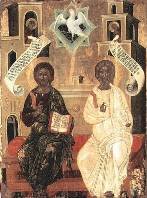
Palamas does not say Abraham saw three angels, or the Logos with two angels, he says quite plainly (as do the services of the Church) that Abraham had a vision of the Holy Trinity. Which is why the famous icon by St. Rublev, and those modeled after it, have historically been appropriately titled: "The Holy Trinity".

Saint Joseph of Volotsk: (+1515)

A Message to an Icon Painter and Three "Words" on the Veneration of Icons
https://azbyka.ru/otechnik/Iosif_Volots ... -ikon/#0_3

Word 3. On the heresy of the Novgorod heretics, who say that it is not proper to depict the Holy and Consubstantial Trinity on icons: "For Abraham," he said, "saw God with two angels, but not the Trinity." Here is a statement from the divine scriptures that Abraham saw the Holy Trinity, and that it is proper for Christians to depict the Holy and Life-giving Trinity on all-honorable icons.

and Cyprian's anti-traditional, disturbed conspiratorialism...

"After prayer, counsel, and careful consideration, speak the truth as you see it. Do not let anyone discourage you by saying that you are a “conspiracy theorist” or that you are “paranoid.” These words are not arguments; they are just insults, and they don’t prove anything." —Priest Steven (Allen)

User avatar
Cyprian
Sr Member
Posts: 889
Joined: Sat 12 November 2005 6:40 am
Faith: True Orthodox Christianity
Contact:

Re: Russia war

Post by Cyprian »

Thomas Deretich, you are a despicable and loathsome heretic, having inherited the malevolent spirit of your perverted and disgraced HOCNA elders, who repeatedly engaged in campaigns of slander, in malicious attempts to malign and besmirch the memory of pious and saintly Orthodox Christians.

You are lazy and negligent, exhibiting poor scholarship, relying upon tedious, protracted and unreliable AI summaries, that go on for pages and pages, in order to try to make your vile arguments.

Just as with poor deluded Barbara, I am through with you and your slander. Not of me. I don't care all that much if you mock or reproach me personally. It's yours and Barbara's totally uncalled for maligning of the saints and your heresies against the Faith, that I find repugnant.

You are going straight on ignore. I wish there was a block feature, so you could not see any of my posts, but I will have to settle for an ignore feature.

I think I will begin praying to St. Augustine of Hippo and St. Seraphim of Platina, that God will banish you from this forum forever, until such time as you repent, and beg these saints for forgiveness. I hope others will consider doing the same.

Thomas_Deretich
Sr Member
Posts: 537
Joined: Fri 14 September 2012 10:23 pm

Re: Russia war

Post by Thomas_Deretich »

I may create a new registration-required thread on how conspiracism is incompatible with Orthodox Christianity. I hope Cyprian keeps an open mind and reads it. In the meantime, allow me to post one last contribution to this thread, debunking the "Protocols" delusion, based on serious academic research.

The “Protocols of the Elders of Zion” (1903, 1905, 1906, etc.) is a forgery/fabrication/fraud. It is not a transcript or summary of any real meeting, but plagiarizes from several known fictional sources, with up to forty percent plagiarized from Maurice Joly’s fictional “Dialogue in Hell” (1868). The “Protocols” was a frequently-changed text over its approximately 20 early Russian versions (1902–1917) with over 5000 contradictions (see the 3200 plus footnotes in De Michelis). Even the editions edited by a single known editor (Krushevan; Nilus; Butmi) have numerous internal contradictions, nonsense passages, and wording inaccurately translated from French. The economic sections of the “Protocols” were an attack against Tsar Nicholas II’s economic policies that were being implemented by his finance minister, Count Sergei Iul’evich Vitte (Witte). These attacks against the tsar’s economic policies undeniably echo (and probably borrow from) the published economic attacks by Il’ia Tsion (Élie de Cyon) and Georgii Butmi (Butmi-de-Katsman) against Vitte’s (and the tsar’s) economic policies. One intent of these economic writings (de Cyon; Butmi; economic sections of “Protocols”) was to pressure Tsar Nicholas into changing economic policies. The Russian texts of the “Protocols” retain some western Ukrainian language characteristics that exist in Bessarabia/Moldavia. Both Krushevan and Butmi had connections to Bessarabia. We know that Butmi, Krushevan, and Nilus each altered the fabricated and evolving text to fit what they wanted it to say. We do not know precisely what text each one started with. One theory is that de Cyon, in France and Switzerland, plagiarized Jolly’s text into an anti-Vitte attack (probably still in French) and it was later used by others in Russia. It is uncertain what role Pëtr Rachkovskii of the Russian secret police in France may or may not have played. We do know that Juliette Adam (who had known Joly), de Cyon, and Rachkovskii interacted with each other. But Rachkovskii was pro-Vitte and suspicious of de Cyon. So, we know much about the anti-Vitte circles out of which the anti-Vitte polemics emerged in Frace/Switzerland and in Russia, we know that both of these circles engaged in proven forgeries, but some of the specifics about the evolving fabricated text (especially earlier stages) cannot be specified precisely and with certainty.

Jn: πάτερ ἅγιε, τήρησον αὐτοὺς ἐν τῷ ὀνόματί σου. CyrA: ἐν ὀνόματι τοῦ Πατρὸς … οἱονεὶ τὸ ἐν δόξῃ καὶ δυνάμει θεότητος…. Πατρός ἐνέργειαν. 1Clem: τῶν ἐν καθαρᾷ συνειδήσει λατρευόντων τῷ παναρέτῳ ὀνόματι αὐτοῦ…. τὸ ἀρχέγονον πάσης κτίσεως ὄνομά σου. HermSim: τὸ ὄνομα τοῦ Υἱοῦ τοῦ Θεοῦ μέγα ἐστὶ καὶ ἀχώρητον καὶ τὸν κόσμον ὅλον βαστάζει . GrP: ὅτε μίαν Θεότητά φαμεν, πάντα ὅσα ἐστὶν ὁ Θεός φαμεν, καὶ τὴν οὐσίαν καὶ τὴν ἐνέργειαν. GrP: ἑκάστη δύναμις ἢ ἐνέργεια αὐτός ἐστιν ὁ Θεός. GrP: τοῦ θείου ὀνόματος…. μόνῳ Θεῷ. MēnJan6: δοξάζηταί σου τὸ πανάγιον ὄνομα, σὺν τῷ Πατρί, καὶ τῷ Ἁγίῳ Πνεύματι. JnKr: Имя Божіе есть самъ Богъ. TikhM: Имя Его не считать за сущность Божию, не отделять от Бога, не почитать за особое Божество, не обожать букв и звуков и случайных мыслей о Боге

Post Reply