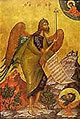
Flavian of Constantinople's written appeal to Pope Leo of Rome, composed directly after the Council of Ephesus 449 which deposed himself, Eusebius of Dorylaeum, Patriarch Domnus II of Antioch, Ibas of Edessa and Theodoret of Cyrrhus and exonerated Eutyches of Constantinople. The letter was smuggled out of the city by Leo's legate Hilarius with much difficulty; and led to Leo's convocation of the Council of Chalcedon two years later.
APPEAL OF FLAVIAN.
Flavian, to the most religious and holy father and Archbishop Leo, greeting in the Lord.
With good cause at the present time I purpose a further reference to your holiness, by way of apostolic appeal, that you may visit the East and rescue in its imminent peril the godly faith of our holy fathers, which they with laborious defence have handed down to us. For lo, all is confounded; the laws of the Church are broken; the faith is destroyed; godly souls are bewildered by controversy; the doctrine of the fathers is now no longer called the faith, but by the authority of Dioscorus the bishop of the Alexandrine church and those who hold with him the teaching of Eutyches is now extolled and called the faith. This he has established by his own decree and by the suffrages of bishops giving a forced consent. All the circumstances it is impossible for me at this moment to report to you blessedness, but I will briefly explain what has happened.
We arrived at the city of Ephesus according to the godly writ of the emperors which was issued to all of us alike. There met us there moreover the representatives of your holiness, the bishop Julius, our most religious son the deacon Hilarus, and our right beloved son the notary Dulcitius. We spent ten days in the city of Ephesus, finding almost all the assembled bishops in complete agreement with us, except the company of the bishop of Alexandria, who, from the day that I was ordained bishop has, without any cause, pursued me with implacable enmity. He has never judged me worthy of his letters, nor shown me the charity inculcated in the teaching of our Lord, though I have always, to this very day, treated him with all respect.
Taking us by surprise, on Monday the sixth of August, without any general agreement or previous arrangement, he calls the council together at dawn [removing me also from my higher place].
When we were seated in the church he called for the reading of the godly writ of our most religious Emperors; but though the whole company of the bishops then proposed that after this reading our first business should be to treat of the holy faith, producing and reading the confession of the Three-hundred-and-eighteen and the doctrine formerly professed at Ephesus, the aforesaid reverend bishop Dioscorus prevented this being done; but, giving orders that I and the bishops who sat in judgement with me, and my clerks also, should not be allowed any hearing or the utterance of a word of defence on any point, threatening also some with deposition, some with imprisonment, others with various punishments, he clears the way for the immediate reading in our presence of an account of the matter previously prepared by Eutyches.
After this he directed the aforesaid Eutyches to put in a written charge against me, and when this was read, treating me as unworthy of any argument or question, he rose at once to his feet, declared him Catholic, reinstating him in the priesthood, and also compelled some bishops against their will to make the same declaration, and to speak in this fashion before the sacred synod: “Eutyches believes aright, he is Catholic;” “We believe as Eutyches believes;” “Brethren, let us hold the faith of Eutyches;” and “Whoso does not agree herewith, let him be anathema;” and “Whoso does not agree herewith, let him be anathema;” and “Whoso shall not confess two natures of Christ before the union, but one after the union, let him be anathema;” and “Whoso questions or asserts anything else but that the Lord had flesh of one consubstantial with us, let him be anathema.” This done, he proposes a decree in his own terms, compelling some, as I have said, to follow him, though with tears.
Shortly afterwards he proposed the reading of the Canons formerly enacted at Ephesus, in which is contained the decree that if any one attempt to disturb the settlement there made by the fathers, being a bishop, he shall be deposed, and so on. That sentence should be effective against Eutyches, who so openly declared himself for the introduction of Apollinarianism. Yet, Dioscorus did nothing of the kind, but proposed the condemnation of me and Eusebius, the bishops all weeping, and would not grant to their entreaties a postponement for a single day; and having made this motion he compelled some of the other bishop to assent to this abominable condemnation, swords being drawn upon those who wished for a postponement on the ground that he would not allow the letters of your holiness to be read, since that would sufficiently establish the faith of our fathers, but [neglecting] what might open the way of truth even to angry and brutal minds, and requiring statements irrational and full of blindness to be received and read, he treated your delegates as if they were unworthy to utter a single word; but with a sort of rush, shamefully managed by him alone, all wrongs, so to say, were suddenly packed into one day, riot, the restoration of the condemned, the condemnation of the innocent—of me who have never in any way thought of transgressing against the authority of the fathers. And since all was going unjustly against me, as if by a settled agreement, after the iniquitous proposal which, of his own motion, he levelled at me, on my appealing to the throne of the Apostolic See of Peter, the Prince of the Apostles, and to the holy council in general which meets under your holiness, a crowd of soldiers at once surrounds me, prevents me from taking refuge at the holy altar, as I desired, and tried to drag me out of the church. Then amid the utmost tumult I barely succeeded in reaching a certain part of the church, and there hid myself with my companions, not without being watched, however, to prevent my reporting to you all the wrongs which have been done me.
I therefore beseech your holiness not to let things rest in regard to this mad plot which has been carried out against me, since there are no grounds produced for bringing me into judgement; but rise up first in the cause of our right faith which has been recklessly destroyed; and further, in view of the violated laws of the Church, assume their guardianship, simply stating the facts throughout to the more honourable among the people, and instructing with suitable letters our faithful and Christian Emperor; writing moreover to the clergy of the holy church of Constantinople, and the very religious monks, also to Juvenal bishop of Jerusalem, to Thalassius of Cappadocian Caesarea, to Stephen of Ephesus, Eusebius of Ancyra, Cyrus of Aphrodisias, and the other holy bishops who have consented to the base plot against me, and to Dioscorus who lorded it, so to say, over the sacred synod at Ephesus; issuing a decree also, as God shall inspire your mind, that an united synod of the fathers both of West and East may be held, and the same faith preached everywhere, that the constitutions of our fathers may be upheld, and all be brought to nothing and undone which has now been effected evilly and darkly by a sort of gamester’s trick; so healing this terrible wound which is now creeping and spreading over almost the whole world. Those, however, who under great pressure of violence subscribed and consented to this unjust sentence, are very few in number. The bishops who did not consent to this iniquity are much more numerous, as the reading of the above written report to your blessedness will explain.