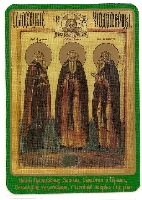
Short summaries of 2 of the 4 outstanding Old Rocor Hierarchs who reposed 50 years ago this year !
That really says something that four traditional-minded Rocor Archbishops would have reposed the same year -- which was exactly a decade after the repose of St John Maximovitch in 1966
I see some significance in that.
This is a pastoral letter from the current Rocor Metropolitan Nicholas to the Eastern Diocese of the US, where the 2 Archbishops profiled here served.
Contains advice that benefits everybody to read through, comparing Archbishops Averky and Nikon's advice for their flocks with the challenges facing Orthodox clergy today.
Great counsel for priests and deacons to get off their smart phones as much as possible !
Sometimes, it's needed but other times it's just passing the time unprofitably.
"Reverend Fathers, my dear concelebrants at the Altar of the Lord!
This year, the Russian Orthodox Church Outside of Russia prayerfully marks a significant anniversary: 50 years since the repose in the Lord of several great luminaries of Orthodoxy in the Diaspora: Archbishop Averky (Taushev) of Syracuse & Holy Trinity († April 13, 1976), Archbishop Nikon (Rklitsky) of Washington & Florida († September 4, 1976), Archbishop Savva (Raevsky) of Sydney, Australia & New Zealand († April 17, 1976), and Archbishop Nikodim (Nagaev) of Richmond & Great Britain († October 17, 1976).
Their earthly journeys concluded in the same year, which became a significant historical milestone. Looking back, we see in them not merely administrators or theologians, but true pastors, whose reverent approach to the divine services, zealous preaching of the Word of God, and dedication to their archpastoral ministry remain an enduring standard of Church life for us all.
In 2023, by God’s grace, I addressed you specifically regarding the 150th anniversary of the births of Metropolitan Anastassy (Gribanovsky) and Archbishop Vitaly (Maximenko) (see letter No. 08.52.23). In this present address, however, I would like to focus on two of the aforementioned pillars, thanks to whom the Eastern American Diocese stands and flourishes: namely, Archbishops Nikon and Averky.
ARCHBISHOP NIKON
Archbishop Nikon (born Nicholas Pavlovich Rklitsky), a native of the Chernigov region, endured the crucible of the Civil War, evacuation, life in Belgrade, and long years of archpastoral labor in the United States. He became a closest associate, and later the biographer, of Metropolitan Anthony (Khrapovitsky), who reposed 90 years ago.
Archbishop Nikon’s ministry is remembered by our flock as a manifestation of boundless paternal love, pastoral flexibility, and incredible missionary zeal. He cared deeply for every person in the Diaspora, supported the establishment of missionary parishes, and always exhorted his flock to cherish and love their parish priests.
His approach to divine worship was profoundly Eucharistic and Paschal. He viewed the Church as a living organism united by the Savior’s prayer in Gethsemane: "The Lord offered His prayer in Gethsemane before His Passion… In this prayer, the Lord, as the omniscient God and our personal Savior, embraced every human being with His compassionate love, praying for each of us… Likewise, a pastor is called to embrace his flock with compassionate love."
Regarding Metropolitan Anthony’s pastoral ministry, Archbishop Nikon wrote in his works: "He saw the essence of true pastoral care in the fact that pastors must be imitators and co-workers of Christ, embracing their flock with compassionate love and leading the people toward spiritual renewal."
Archbishop Nikon’s burial place is the lower St. Olga Church of St. Vladimir Memorial Church dedicated to the Millennium of the Baptism of Rus’, where he reposes alongside his predecessor, Archbishop Vitaly. To this day, the hearts of the faithful are drawn to their graves, seeking spiritual fortification and grace-filled aid. As we mark the 50th anniversary of his departure to the Lord and contemplate the fruits of his earthly labors, we offer prayers that future generations, too, will honor his name and memory.
ARCHBISHOP AVERKY
Born in Kazan into an aristocratic family, the future Archbishop Averky (born Alexander Pavlovich Taushev) traversed a long path of exile – through Bulgaria and Carpathian Rus’ to Munich, and then to the United States, where for many years he governed Holy Trinity Monastery in Jordanville and its associated seminary. Archbishop Averky earned the reputation of being the "conscience of the Russian Church Abroad," standing steadfastly as a guardian of the purity of the Patristic Faith.
The central focus of his life was the preservation the spirit of true, undistorted Orthodoxy, attained through prayer and fasting. His Eminence lamented any merely formal approach to prayer and instructed the clergy: "Prayer and fasting are the primary and essential weapons in the spiritual warfare waged by every Christian…"
For Archbishop Averky, the Divine Liturgy was a living foretaste of Heaven, while preaching the Word of God was a sacred duty that could tolerate no compromise with the spirit of the age. He taught that a pastor must be an uncompromising herald of the Truth: "No falsehood befits a true Christian – a servant of the Truth. Falsehood is all the more unacceptable on the lips of the ministers of Christ’s Church."
Through his writings, His Eminence sought to convey the fullness of Patristic theology to his readers. He zealously guarded the unity of the Church and fearlessly denounced any trends hostile to it.
Archbishop Averky reposed in the Lord on April 13, 1976, and was laid to rest in the crypt beneath the altar of the Holy Trinity Cathedral in Jordanville. To this day, his example and writings remain a source of spiritual guidance for believers in many countries.
I present to you several themes, drawn directly from His Eminence, which concern modern temptations associated with the Internet. Since the emergence and evolution of the media landscape occurred gradually, some of the trends observed today were anticipated by Archbishop Averky; thus, in a sense, we already possess his insights regarding these contemporary challenges.
Do not confuse public visibility with ministry.
"Not ‘administration,’ but ‘care of souls’ – a selfless, zealous concern for the salvation of the souls of the flock – this is the essential element of pastoral ministry," writes Archbishop Averky.
Imprudence and errors (and at times, something worse) on the part of priests can cause scandal among the flock more than ever before – precisely because of modern technology.
"Oh, how closely the modern flock watches its pastor, sometimes giving him no peace and seeking out sins in him that do not exist in the slightest…" "The modern pastor must be keenly aware of this and always take it into account, watching over himself and his own behavior so as not to cause scandal to his flock in any way," says Archbishop Averky.
A clergyman is called to conduct himself in a God-pleasing manner not only within the church or in his private life, but also in the virtual world. Archbishops Averky and Nikon never hid behind computer screens, nor did they waste precious time on online disputes, anonymous condemnation, or the arrogant denunciation of "each and every one." They did not indulge in frivolous behavior, irony, or harshness, which do not correspond to their high office and damage the Church’s authority. Instead, they engaged in a genuine apostolic outreach to the people. Their ministry was grounded in living, heartfelt, face-to-face interaction. Coming to the flock, they embodied a good and tangible example of the Orthodox Christian life, warming souls through their personal piety, humility, and pastoral dignity. For the modern cleric, the online space should not be a venue for self-expression or vain debates, but a platform for pastoral and missionary work, which demands the same fear of God as a sermon delivered from the ambo.
Beware of pride masquerading as zeal.
"A pastor’s self-exaltation is the primary obstacle to success in his pastoral ministry." "A true pastor must be an 'example of meekness and humility' to his flock."
Do not equate yourself with the Church.
"To this end, he must not equate himself with the Church. A pastor is not the Church, but merely a servant of the Church…"
"A pastor must call for obedience to the Church, not obedience to himself."
Avoid partisanship, politics, and purely secular content online.
"There can be no phenomenon in the true Church of Christ more unsightly or unseemly than a pastor who harbors other interests… who engages in extraneous, purely worldly affairs…" "…such as, for instance, political activity, which invariably serves only to divide and embitter people..."
Be sincere; do not play to the crowd.
"The second quality, which is absolutely essential… is sincerity."
"There is nothing worse than when the flock… notices in their pastor a discrepancy between his words and deeds…"
"It is worse still when they perceive insincerity, falseness, or pretense in him…"
The importance of prayer (which is higher and greater: prayer or social media?).
"I pray; I pray constantly. I cannot even fathom how one might spend time without prayer. Truly, prayer is the breath of the soul."
The age of information technology has brought a new temptation for the pastor: the imperceptible yet destructive squandering of time. It is entirely unbecoming for a pastor of Christ’s Church to spend hours "lost" in the virtual world or aimlessly scrolling through a smartphone feed, frittering away the treasures of his soul on fleeting worldly vanities. We must remember: time is given to us for eternity. It is entrusted to us by God for ceaseless service to Him and to our fellow man, for fervent prayer and the active doing of good. When a priest is consumed by the screen of a gadget, both his flock and his own spiritual labors suffer, even in those instances where he uses the device with good intentions.
Therefore, it is the duty of every clergyman today to decisively reallocate his inner resources. It is essential to cultivate deep, unhurried private prayer, to recite the prescribed prayer rule reverently and without haste, and to set aside time for the profound reading of patristic and spiritually edifying books. A pastor’s spiritual vessel must be filled daily with the pure water of Holy Tradition, rather than with the noise of information.
Instead of a virtual surrogate for presence, we need to engage in constant, living contact with people. A priest must be in the midst of his flock: conversing personally with parishioners, patiently listening to their sorrows, sharing in their joys, offering support in moments of doubt, and providing comfort with a kind, fatherly word. Only such interaction – living, compassionate, and warmed by love – can heal human souls and build a genuine community.
CONCLUSION
Half a century after the repose of Archbishops Nikon and Averky, we face the same challenges: the secularization of society, the cooling of faith, and attempts to erode the canons of the Church. The memory of Archbishops Nikon and Averky calls upon us to:
A) Kindle reverence for divine worship: To celebrate it not mechanically, but with the fear of God, remembering that the Liturgy is the heart of our life.
B) Preach the Word of God with zeal: To tirelessly teach the flock the truths of the Gospel, regardless of the trends and currents of this age.
C) Preserve pastoral love through living interaction: To be accessible, merciful, and sacrificial ministers to the people, giving absolute priority to real pastoral conversation and comforting the individual over virtual presence.
D) Safeguard time for God: Eliminate idle time spent on one’s smartphone, dedicating the hours thus gained to one’s prayer rule, the reading of the Holy Fathers, and acts of charity.
E) Uphold the spirit of our Church online: Bear in mind that any word spoken by a priest on social media is viewed by the world as the position of the entire Church, and thus demands a heightened sense of Christian responsibility. The Council of Bishops of the Russian Church Abroad in 2001, which elected the ever-memorable Metropolitan Laurus, wrote regarding this: "The Council of Bishops reminds the clergy of our Church that, in all their public statements, they act as representatives of the Church by virtue of their rank and are therefore accountable for them to their ruling hierarchs."
I call upon all rectors and clergy of the Diocese to serve litias for the departed and panihidas this year for the departed hierarchs – Archbishops Averky, Nikon, Savva, and Nikodim – on the appropriate dates for commemorating the departed; I also urge you to take an interest in their writings and to dedicate your sermons to their spiritual legacy.
By their prayers, may the Lord strengthen us all in bearing our pastoral cross!
With love in the Lord,
+NICHOLAS
Metropolitan of Eastern America & New York
First Hierarch of the Russian Orthodox Church Outside of Russia"