The Holy Mountain of Athos is known everywhere for its history, the treasures it houses, but especially for the life of the monks here. In recent decades, many studies have been published and research is being done on the Athonite monasteries, but the main element that makes Mount Athos a place of spiritual rest is the spiritual one. Venerable Dionysius of Colchis (†2004) often said that “The Holy Mountain is a place of peace”, because the monk, “in order to be able to approach the Good Heavenly Father, must have peace”, and “The Holy Mountain is a very helpful place for salvation”.
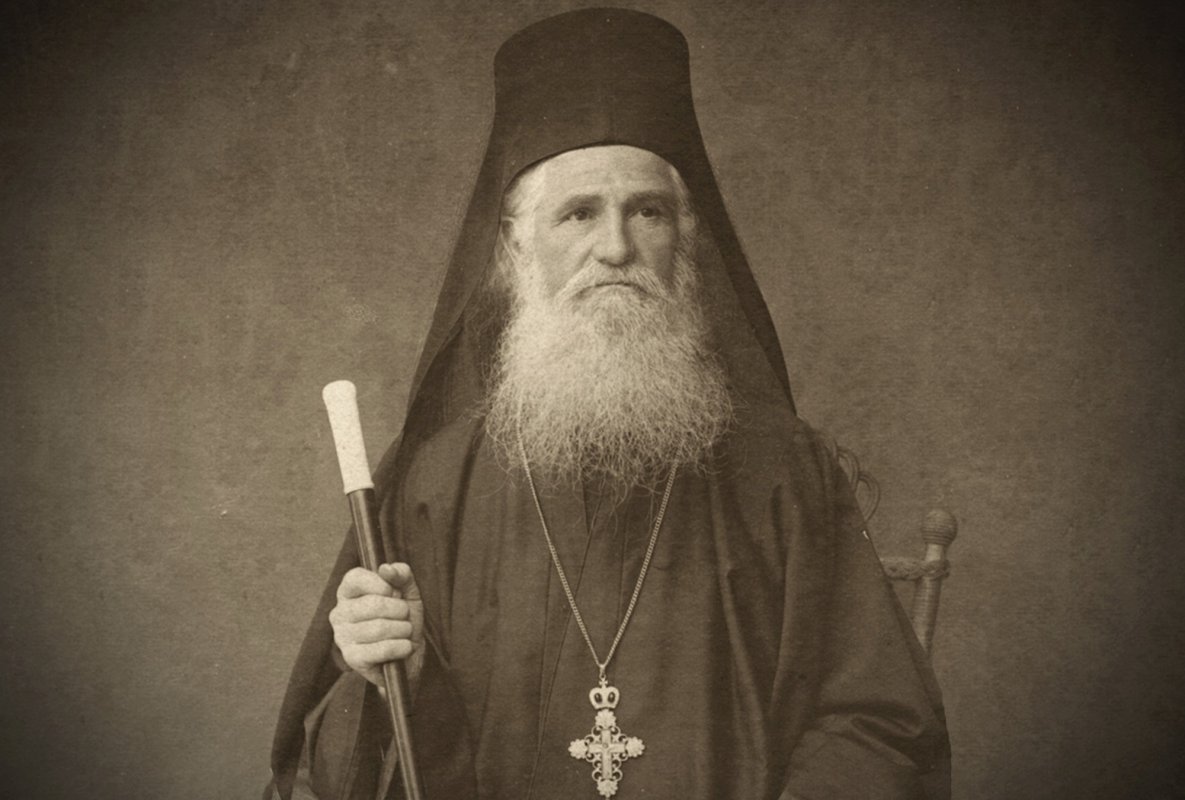
In this "workshop" where prayer is practiced, Archimandrite Antipa Dinescu, a skilled spiritual father and one of the most important Athonite spiritual personalities of the past century, also found spiritual rest.
Father Antipa was born on October 28, 1858, in "Slănicul de Prahova", into the family of the pious Gheorghe and Safta Dinescu. At Holy Baptism he received the name of Saint Archangel Michael. From an early age, he enjoyed a careful education, both religious and "outside", thus attending the courses of the newly opened Commercial School in Ploiești.
About the beginnings of his monastic life, in the Romanian Hermitage of Prodromu, the father wrote: "I made my first prostration at a young age, being 22 years old, on May 10, 1880, and I lived in the Hermitage uninterruptedly, undergoing all the obediences on sea and on land, until September 4, 1914". A Romanian worshiper at the Holy Mountain met Father Antipa when he was still a brother, fulfilling his obedience at sea together with three other young monks "who knew their craft perfectly". At the helm of the boat was Brother Mihail, "the son of a merchant from Slănic, namely Dinescu, and who, after finishing school in Ploiești, had run away against his parents' will here, to the Holy Mountain, out of Christian piety".
On October 25, 1886, young Michael assumed the angelic form, receiving the name "Holy Martyr Antipas, who is mentioned by the Lord in the Apocalypse." The good standing and gifts with which he was adorned were not overlooked, and he was ordained hierodeacon in December 1892. A year later, on May 6, he received the Sacrament of the Priesthood.
He was installed as abbot of the Prodromu Hermitage on May 8, 1900. For 14 years, under his leadership, the hermitage experienced a period of unique flowering in history, gathering over 100 monks to "warm" the imposing walls. Several fathers from that period confessed that the hermitage had "a very beautiful order", it was "a corner of heaven". In the summer of 1907, priest V. Nicolau, from Prahova, arrived at the Romanian Hermitage, just 2 years after the earthquake that affected several Athonite monasteries. He was impressed by the monks who had left and by the fact that, in addition to the main buildings, they also operated "a home for the infirm, a hospital where parents from other monasteries gather and are cared for; they have a pharmacy, hot and cold baths, storehouses, stables, a flour mill, water tanks and, finally, they have a household that does them great honor". Moreover, at that time there were skilled icon painters "researched by the entire Holy Mountain", as well as "good writers of church hymns", translators or "various craftsmen", because they did not let "the available time be wasted, but each one occupied himself with what nature had endowed him with".
However, several temptations arose "which embittered" Father Antipa "in the midst of his labors", precisely "at the moment when generosity was demanded from everyone". Thus, the misunderstandings that arose caused the father to leave the hermitage abbot in September 1914.
After leaving the Prodromu Hermitage, Father Antipa returned to Romania. Not many details are known about the period he spent in the country. What is certain is that, in the summer of 1920, Patriarch Miron Cristea, then Metropolitan Primate, knowing the personality of the Athonite hieroschemamonk, elevated him to the rank of archimandrite and placed him at the head of the community in Căldărușani. Unfortunately, the weakening of the monastic mind meant that "Archimandrite Antipa, a good monk, of a contemplative nature", was considered "lacking energy", and his emphasis on the spiritual element was not taken seriously by the monks of that time. Therefore, at the end of 1923, he left the abbotship, retiring to the Holy Mountain.
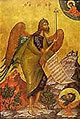
From that moment on, the spiritual father Antipas could be found in his humble hermitage on the estate of the Stavronikita Monastery, as he noted: “in 1924 (...) I came from Romania to find peace.” In that “hive of virtue,” located above the sea, the lover of hesychia worked “the honey of Christ.” His primary concern was the prayer of the heart, as he also taught his disciples in his spiritual testament, urging them: “not to speak much and vain things, but rather to say spiritual words from the Patericon and to say the prayer ‘Lord,
Jesus Christ, Son of God, have mercy on me, as much as you can.’” The father's inclination towards the inner, hesychast life, so that "the secret man of the heart" might be "in the incorruptible adornment of a gentle and quiet spirit, which is of great value in the sight of God" (1 Peter 3:4), can also be easily observed from the numerous manuscripts that he copied, hundreds of philological pages, for his own benefit, but also for those who read or transcribed them. On the first page of such a spiritual treasure house he wrote: "very useful teachings for those who engage in quiet prayer of the mind in the heart."
Several Romanians crossed the threshold of the cell of the spiritual father Antipa, a fact recorded with special piety in their writings.
In 1929, hieroschemamonk Daniil Sandu Tudor, while still a layman, made a journey to Mount Athos, from where he returned "with a rich experience." There he encountered "that discreet attentiveness of the heart that is characteristic of hermits." One of these hermits was the confessor Antipa, "an old abbot, over 70 years old, with hair as white as the light of white silk," where he had a special "encounter of spiritual love, without lived evidence, beyond words." About him, Father Daniil said that he had before him a "yellowish silence, a color of transparent peace," which, in fact, was "the color of hunger long overcome and the labors of prayer, of long sleepless nights spent in liturgy and litanies by the mysterious light of few torches in a narrow, smoky chapel."
In 1931, the priest and historian Paul Mihail (†1994) undertook a study trip to Greece, to Mount Athos and Constantinople. At the end of July of that year, on his way to the Stavronikita Monastery, he spent a few hours with “Archimandrite Antipa Dinescu, a model monk”. About him he added: “Archimandrite Antipa is an elderly man, serene, he is completely white, dry, he resembles a saint on an icon. He showed me several personal manuscripts”. In a 1992 review of the travel notes published by Father Mihail, academician Virgil Cândea wrote with conviction about the spiritual father Antipa that “he will soon enter, through canonization, into the synaxarion of our Church”.
We should not overlook the fact that March 1939 brought to the foot of Mount Athos two young men, celibate deacons, from the Transylvanian Metropolitanate: Zian Boca and Dumitru Popescu, the future spiritual fathers Arsenie and Seraphim from the Sâmbăta de Sus Monastery. The task of their spiritual guidance fell to Archimandrite Antipa, at whose cell the two young men, thirsty for the mysteries of monastic life, often stayed. Father Arsenie returned to the country after three months and brought with him, along with the agonized teachings, a notebook with philological writings copied from the rich collection of manuscripts of his Athonite spiritual father. Father Seraphim Popescu extended his stay on Greek territory by continuing his studies in Athens, remaining in close correspondence with the Romanian fathers from the Holy Mountain. Thus, during his studies, he received an exhortation from the spiritual father Antipa, for his entire life: "Stick to the rule, so that you do not become possessed!".
The charisma of spirituality, which shone in the person of Father Antipa, could not be hidden, for this reason important testimonies remained, some of them only about his presence. For example, in 1938 he passed by the Vatopedi Monastery, and the monks of that time stated that "this father should not recommend himself as a spiritual father, that his presence recommends him."
Elder Dionysius Ignatius had feelings of special piety towards Father Antipas, his spiritual father and intercessor from his youth, about whom he said: “He was very spiritual and advised us a lot, that is, a man close to God”. At the same time, “he was stricter”, because “he sought to be clean, clean, clean; if you went to Thessaloniki, when you came back, he would not let you serve for a week, because he said that ‘you have defiled your eye with your sight, with your touch, with such and such; go and cleanse yourself, read, such and such’”.
Hierodeacon Joasaph (†1993), from the synod of Joasaphs, told his disciples about a miracle he experienced in his youth regarding Father Antipas. Father Joasaph came to the Holy Mountain in 1928. Because he had the gift of singing, he often went from his cell in Karyes to the Stavronikita Monastery to take lessons from the well-known protopsalt of the monastery at that time, Hierodeacon Sinesius (†1949). As a young man, Father Joasaph once had thoughts of returning to the world, the adversary of good inventing for him the fact that there were no more spiritual people, and so on. The teacher, seeing his disciple tempted, said to him: "Let me take you to see that to this day there are holy people here, on the Holy Mountain." So they set off towards the Pantokrator Monastery and arrived at the Forerunner's Cell, located above the sea, where Father Antipa was working on his salvation. Father Sinesie was carefully instructing his disciple: "See how much he has become familiar with nature, that animals are not afraid and approach him." Arriving at the hermitage of the Romanian spiritual father, they received the traditional kerasma (treat), that is, a fig, some water and tsípuro (traditional Greek drink). Then, Father Sinesie asked him: "Elder, will you call the birds to come here?" And immediately, "the Romanian in his language begins to call them. Then, from all sides of the horizon, birds ran and came to him. They sat on him, from head to toe, on his clothes, on his hands, on his shoulder, on his head. Still full of birds. Not just one bird. Full! He was full of birds! They were flying all around. Wild birds. He tamed other animals, foxes, wild rabbits."
The years were "in full swing" for Father Antipa, exceeding the eighty years spoken of by the Psalmist, and in the second half of 1942, the Romanian spiritual father from the Cell of Saint John the Baptist passed away, leaving behind his two disciples - Eftimie and Lazar -, along with a spiritual legacy that still endures.
The contribution that Archimandrite Antipa Dinescu made to the life of the Church, especially through his quality as a spiritual father and philolocal father, a lover of prayer and peace, cannot be denied according to the word of the Gospel, which says that "a city set on a mountaintop cannot be hidden" (Matthew 5:14).