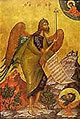
Since at least the end of the nineteenth century it has become traditional for at least one bishop of the Ecumenical Patriarchate to be permanently residing on Athos at all times in order to act as a representative of the Patriarch and to perform ordinations for Athonite monks to the diaconate and priesthood. Below is a list of several of the bishops who have made the Holy Mountain their permanent residence for the past hundred years:
Metropolitan Nilus of Karpathos and Kasos (1836 – August 9, 1917)

He was born in the village of Piali, Tegea, Arcadia, in 1836 to pious parents. His real name was Nikitas Smyrniotopoulos and he had four siblings. As a child, he also worked as a shepherd. He then studied at the Rizareio School in Athens. At the age of twenty, he entered the monastery of Koutloumousi, where he was tonsured a monk by the venerable abbot Ioasaf the Byzantine. He was later ordained a deacon and a presbyter.
He then left for Ephesus under Metropolitan Agathangelos († 1893). He studied at the Theological School of Chalki. He served as a preacher and teacher in Kydonies, Smyrna and Ephesus. He was ordained assistant bishop of Erythrae. He was promoted to metropolitan of Karpathos and Kasos. For two years he shepherded his province. He resigned and departed for Mount Athos. He became a monk in the Kalyve of Ypapanti of the Koutloumousian skete of Saint Panteleimon, then in the Koutloumousian Cell of the Great Virgin Mary, living with rigor, industriousness and asceticism. He continued this life, living alone in a Koutloumousian house in Karya and in the Simonopetritic Cell of Saint Minas. According to Hieromonk Christopher Docheiaritis, "he lived a very simple and abstinent life, very rarely eating baked goods, and never drinking wine or any other alcoholic beverage, except when called upon for priestly service, and even then only very little and mixed with water, and only so as not to cause scandal." Although some misunderstood him as a money-grubber, his avarice was evident from his large donations. When he learned that several churches in Thessaly had been destroyed in the war of 1897, he went there and offered priestly vestments, which he had sewn himself, for he was also a good tailor, as well as other vestments and sacred vessels.
Then he went to his homeland, where he built a primary school, a schoolhouse and an archaeological museum and made many donations to the churches. In Constantinople, he donated to the library of his foster school, the Chalki School, and to charity shops. He stayed in Constantinople for a long time, always living frugally, serving the needs of the Christians, who soon appreciated and loved him and everyone asked for him in their churches. The little money they gave him, they knew well that it would not be long in going to the poor. He also made rich donations to the Patriarchate.
He also served as the headmaster of the Athonia School. In 1913, he was very happy to go to Mount Athos and see it liberated from the Turkish yoke and the Greek flag flying everywhere. According to Christopher Docheiaritis, "you were urged by the late Chariton of Koutloumousianus and by me, as you were on Mount Athos, where you enjoyed the greatest respect, honor and esteem, not only because you were a model ascetic, but also because of the national donations, and you were persuaded to say that you were marching to Constantinople, to receive the Greek troops with the precious Cross and to perform the service in the holy church of the Holy Wisdom of God..."
The sparing in praise M. Gedeon characterizes him: "living a simple, ascetic, Christian life, not hoarding for himself but being rich in God, according to the Gospel, always poor, doing good". He passed away in the national hospital of Constantinople on 9.8.1917 and was buried in the cemetery of the Life-Giving Spring of Baloukli.
Metropolitan Photios of Moschonisia (1871 – October 1, 1930)

Dimitrios Marinakis was born in the Alatsata Fountain in Asia Minor in 1871. In 1920 he was enrolled in the holy monastery of Xiropotamos. After he resigned his see in 1922 he left permanently for the Holy Mountain.
In 1926 he came to the holy Caracalla Cell of the Galatsani, which they themselves painted, of the Nativity of the Theotokos-Karya, opposite the all-revered Holy Church of Protatos. He was invited to many Athonite festivals and performed several ordinations of Athonite fathers. He was a merciful and beloved archpriest, who especially loved Mount Athos.
He rested on 1.10.1930 in this Cell, where he was buried. His bright yellow coffin is kept there to this day, a sign of the virtuous life of the humble metropolitan.
Metropolitan Hierotheos of Miletopoulos (1874 – January 20, 1956)

John Giachopoulos, son of Anthony and Catherine, was born in Premet, Northern Epirus, in 1874. He studied at the Theological School of Chalki. In 1900 he was tonsured a monk. In 1907 he followed the Metropolitan of Trebizond and later Ecumenical Patriarch Constantine the Great (+1930), who promoted him to Metropolitan of Militoupolis. As a patriarchal envoy to Korçë, he worked persistently and patiently for the upliftment of the faithful. However, the Albanians expelled him.
He retired to Mount Athos in 1930, and initially stayed in the Lavriot Cell of Saint Eustathius-Mylopotamos, where the Ecumenical Patriarch Joachim III was also exiled for months. Then, in 1935, he stayed in the Cell of Saint Eleftherios-Vouleuterion, on the beach of the skete, Saint Anne. He stayed on Mount Athos for about three decades. His stay there is distinguished for his landlessness, his simplicity, his aversion to money, his asceticism, his love of followers and his charity.
But let us better let those who knew him speak: "The late one was the embodiment of holiness. He had completely hated money, and having complete avarice, when he received the hierarchal allowance, he immediately distributed it to the needy. During the famine of 1941, he remained constantly fasting in order to feed others. A year ago, having nothing else to offer, he offered his only robe… A devoted follower of the Aga, he remained during the vigils on the high priestly throne like a towering oak, standing for 15 and 18 hours… He also showed himself to be the embodiment of humility, meekness, and unwavering faith… Whatever he may say about his forbearance regarding sleep and food, is little. He was in no way disturbed by desires for a good life. His restraint had turned into ascetic restlessness. If we observe him during the holy vigils, we would say that he seemed to have completely overcome the desire for sleep. The deceased was an example of almsgiving. "Aktimon as a true monk, abstaining and abstaining again and again and always offering himself and benefiting all. He honored the Church. He was devoted and devoted to the Lord."
The only property left by this venerable hierarch, “the modesty of high priests” and “a model of duty”, was a holy chalice for the temple of Protatos, an icon for the Sunday service of the hermitage of Saint Anne and a little food, which was distributed as a blessing to the needy hermits. “In the middle of the month of January, the bishop of Miletopolis, Hierotheos, who had served him since childhood, passed away to the Lord, full of humility and holiness.”
He reposed in the Lord on 20.1.1956. The blessed Elder Gabriel Dionysiatis (+1983) writes thoughtfully about him in an obituary: “The Holy Fathers, without hesitation, have been proclaiming for years, ‘such a one should be our high priest.’ A high priest of penance. However, many of his colleagues, visitors and pilgrims, having other criteria for earthly life, ‘hang their heads, saying, ‘He saved others, himself he could not save.’” And he, who was raised above earthly things, not caring for praise or reproach, set one goal of his life, charity, from which he left as pure fruits his spiritual children, holding enviable positions in universities and the highest Hierarchy of our Church, and he was entitled to say “here is my wealth”, and he never said it, out of humility and modesty. He has already departed to the desired Christ and the fathers of the Mount wish from their hearts that the memory of the blessed Lord Hierotheos of Melitopol may be eternal.”
Metropolitan Nathanael of Koos (1919 – August 13, 1978)

The worldly Chrysostomos Dikaios of Demetrius and Constantine was born in the village of Agridia on the island of Imbros in 1919. Seeing his great love for the Church, the then Metropolitan of Imbros Iakovos (d. 1980) sent him in 1937 to study at the Athonia School. The following year he was tonsured a monk at the Great Lavra. In 1939 he was ordained a deacon by Hierotheos of Miletopolis (d. 1956). In 1944 he went to the Middle East. He was ordained a presbyter in Gaza by Metropolitan Panteleimon of Karystia (d. 1962). He was enlisted as a military chaplain and took part in the battles of Rimini.
He then studied at the Theological School of Athens and continued his studies in France.
In 1953 he took over as head of the Athonia. In 1956 he was elected bishop of Miletoupole and ordained in the church of the skete of Saint Andrew of Karyo. In 1963 he was appointed titular metropolitan of Miletoupole. Everyone has good things to say about his headship. They write: “He is a bright hierarchical figure. Educated with rigor and modesty, he is distinguished by his consistency in evangelical principles. He envisioned the return of Monasticism to the ancient coenobitic order and made considerable efforts along the path of true tradition and high spiritual life, in opposition to the expectations of the contemporary world from Mount Athos.”
In 1967, the Ecumenical Patriarchate elected him Metropolitan of Kos. He was accompanied to his see by his brothers, Ambrosios, who immediately made him Protosygellos, later Metropolitan of Karpathos and Kasos, and Chrysostomos, his successor in Athonias, and later Bishop of Rodostolos. All three were subordinate to the blessed Elder Ambrosios Lavriotos († 1977). Ambrose of Karpathos writes about him: "Nathaniel was not only a pillar and founder of the work of the Athoniad, he was also a brilliant educator in Christ and in Godly knowledge and science of many graduates, but also the one who wisely provided for the training of the teaching staff of the Athoniad. A living example of a virtuous life himself and a model of teaching and school leadership...".
The blessed abbot of the Great Lavra, Archimandrite Philip († 2000), continues: “Truly a hierarch, without the slightest exaggeration of words. With genuine sincere humility and with the fear of God, he offered his being to Athonia and indeed founded it and provided for its successors. His offering is not limited to Athonia, it extends far beyond the Athonite boundaries, and if today the name Despot is mentioned on the island of Kos, they mean him alone, and they remember the example and the entire life of Nathanael Lavriot. He also built a hospital, a nursing home, and a monastery with his own efforts and efforts, and his love took deep roots in the hearts of his people. I will not forget the last days, when people passed by under the building of the metropolis to ask how the Despot was doing. I do not forget them, they have been engraved in my soul and I proclaim them, because I believe them. But he did something else too. The Lavra returned from its own rhythm to the blessed community. This is largely due to the blessed Nathanael of Lavriot.” Indeed, the Lavriots wanted Nathanael as their first abbot. However, the Lord called him to heaven and human desires were not fulfilled.
He often said: “My heart is in Mount Athos and my love in Kos”. He reposed in the Lord on 13.8.1978.
Metropolitan Chrysostom of Rodostolou (1933-2025)

He was born in 1933 in Anagennisi, Serres (his secular name was Panagiotis Anagnostopoulos). He was the son of priest Nikolaos Anagnostopoulos, a refugee from Eastern Thrace. After completing his secondary education in Sidirokastro and Serres, he went to Mount Athos in 1950, where he became a monk in 1951. He studied at the Athonias Academy (1953–1956). He served as secretary of the Holy Community of Mount Athos (1956–1958) and then as a student of the Theological School of Halki (1958–1962). He was a professor (1963–1966) and later headmaster (1967–1988) of the Athonias Academy. He was consecrated as a hierarch of the Ecumenical Patriarchate in 1978, as Bishop of Rodostolou. In recent years he lived at the Lavriotiko Cell of All Saints, near Saint Neilos.
He is considered one of the most erudite Athonites of both the older and newer generation, with a rich body of written work, in which he recorded experiences, recollections, and many aspects of life on Mount Athos: Longing and Grace on Athos (2000), Letters and Songs on Athos (2000), Faces and Events on Athos (2001), Ode to the Ever-Blooming on Athos (2004), Theotokos Hymns and Funeral Rites on Athos (2005), When They Spoke on Athos (2007), and others.
His musical education and training were also of great significance. He was initially a student of the Athonite monk Andreas Theofilopoulos, and later, at the Athonias Academy, of the renowned contemporary chanter and teacher Elder Meletios Sykiotis. He often listened to, and sometimes chanted alongside, the great cantors of the older generation: Father Dionysios Firfiris, Deacon Ioannis Ioasaphaios, and Romanos Vatopedinos.