"Andrey Andreyevich Vlasov (1901–1946) was a talented Red Army commander who distinguished himself in the Battle of Moscow, Vlasov was captured by German forces in 1942 while leading the 2nd Shock Army in the Siege of Leningrad.
Disillusioned with Stalinist leadership, Vlasov defected and offered to lead a Russian force against the Soviet government.
The Russian Liberation Army (ROA) consisted primarily of Soviet prisoners of war (POWs) and personnel from security units who chose to fight for the Germans rather than perish in POW camps.
The movement aimed to overthrow Stalin and create an independent Russian state, issuing the "Prague Manifesto" in 1944 which detailed their anti-Bolshevik, anti-imperialist platform.
In 1945, the ROA grew to about 125,000 members.
Oder Front: The First Division of the ROA engaged in its first battle against the Red Army in February 1945.
Prague Uprising: In May 1945, some ROA units unexpectedly assisted the Czech resistance against the German occupiers in Prague.
Surrender and Fate: The army tried to surrender to American forces to avoid Soviet vengeance.
However, many were handed over to the Soviets.
See Euphrosynos Cafe thread on the Cossacks and others who suffered the same horrible tragedy
General Vlasov and other leaders were tried in Moscow and executed by hanging on August 1, 1946.
The legacy of the Vlasov Army remains a sensitive topic in Russian history, often debated in the context of treason versus anti-Soviet resistance."
Today's Russia has viewed the Vlasov project extremely negatively, chastising Rocor members whose relatives enthusiastically took part in the ROA as : traitors to "the Motherland"
Whereas Rocor, generally speaking, sympathized with that goal of getting rid of Stalin. [Who wouldn't, especially if one was a Russian emigre from the Bolshevik Revolution or a later refugee from the Soviet Union ?]
I did some reading about this epoch and recall that Vlasov and his movement were secular, though, not Orthodox. There were other anti-Soviet Russian movements which were more Orthodox-Church oriented.
Though Vlasov attended a Russian Orthodox seminary in his youth, he seems to have lost his faith somewhere along the way, no doubt in the climb thru the ranks of the Red Army.
A priest noted in a diary entry that Vlasov did not receive Communion nor confess during the years of World War II, a perilous time when one would imagine one would MOST be in need of the Sacraments.
Jewish questions
Re: Jewish questions
Re: Jewish questions
Rocor-MP's Synod's 2009 Epistle is below.
The missive tries to be as diplomatic as possible toward the Russian Federation and MP
while still standing up for the Church Abroad's historical ideals and members who participated in the ROA
Note the use of the traditional Russian term Fatherland for Russia
as opposed to the Soviet "Motherland".
"bolshevism" is not capitalized, perhaps to play Communism's darkness down a little as the Soviet Union was still a recent memory in 2009 for many RF citizens - and even a positive memory for quite a number.
Note also the interesting observation at the end of the Epistle that many in Germany were during World War II - and remain today - opposed to a strong central govt. in Russia
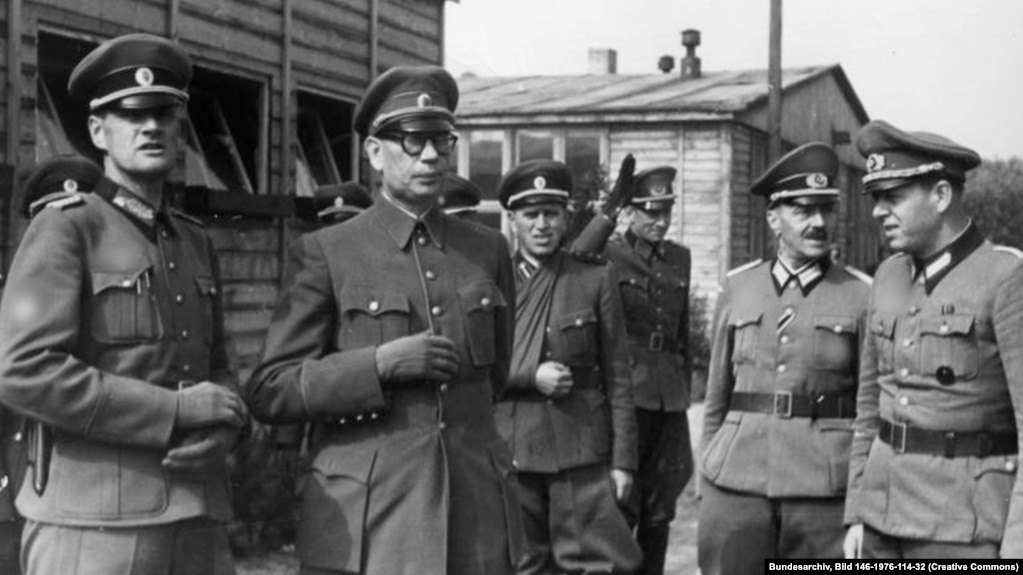
General Vlasov south of Berlin in 1944 with other ROA members
[photo credit : Radio Free Europe]
In fact, I think the ROA was mainly the project of one German officer, Captain Strik Strikfeldt.
Actually many German officials including the Fuhrer himself opposed the ROA movement due to Hitler's - demonic - characterization of the Slavs as 'subhuman'.
"NEW YORK: September 8, 2009
The Synod of Bishops Comments On Protopriest George Mitrofanov’s Book, "The Tragedy of Russia. Forbidden Themes in the History of the 20th Century"
During its September session, the Synod of Bishops of the Russian Orthodox Church Outside of Russia discussed the polemics revolving around the book published this summer by a church historian, Professor of St Petersburg Theological Academy Protopriest Georgy Mitrofanov, titled Tragedija Rossii. “Zapretniye temy istorii XX veka [The Tragedy of Russia. “Forbidden” Themes in the History of the 20th Century].
The book is a compendium containing published articles and sermons written and delivered by Fr George from 1990-2000.
We are saddened by the glaring vitriol in the arguments surrounding this book, and the contentious and disturbed spirit expressed by some of the critics of this book.
Since the matter involves a compendium which includes the works of Fr Georgy written over almost a decade, we will allow ourselves to touch upon only one of the topics, the historiosophical and historical evaluation of General AA Vlasov.
It was this topic that set off the more painful disputes among Russian Orthodox Christians both in the Fatherland and in the diaspora.
The tragedy is indeed a great one surrounding those who are commonly called “Vlasovites,” that is, the participants in that movement upon which the Russian Freedom Army [Russkaya Osvoboditel’naja Armija, ROA] was founded.
In any case, it must be examined without bias and with complete objectivity. Without such an approach, the science of history becomes political propaganda.
It seems to us that for a better understanding of what happened in Russia, and with Russia, in the critical years of the last century, we must avoid a black-and-white juxtaposition of historic events.
These events by their very nature were so complex, so self-contradictory and multi-layered, that an attempt to characterize them with one label is doomed to failure.
In particular, calling the actions of Vlasov treasonous is in our opinion a superficial simplification of what happened. In this regard, we fully support Fr Georgy’s effort to approach this question (in fact, a whole series of questions), with a suitable yardstick for this problem.
In the Russian Diaspora, where some of the survivors of the ROA found themselves, General Vlasov was and remains a symbol of resistance to godless bolshevism in the name of the rebirth of Historic Russia.
Under the circumstances they found themselves in, could General Vlasov and the “Vlasovites” have done anything else?
We hope that future Russian historians view those events with more fairness and objectivity than we see today.
Yet to the question “Were General Vlasov and his supporters traitors to Russia?” we can answer, no, not at all.
Everything they did was for the sake of the Fatherland, in hopes that the defeat of bolshevism would lead to the rebuilding of a powerful national Russia.
Germany was viewed by the Vlasovites solely as an ally in their struggle against bolshevism, but they, the Vlasovites, were prepared if faced with the need to use armed resistance against any colonization or division of our Homeland.
Paraphrasing the famous words of the late Russian philosopher Alexander Zinoviev, General Vlasov and his followers, while “taking aim at communism” took all imaginable measures “not to hit Russia.”
And this attitude, these efforts were not muted among the Vlasovites, and so those in Germany and other countries who hated Russia did all they could to prevent the creation of a battle-ready Russian Freedom Army, let alone a Russian national government.
An in-depth study of the history of the ROA and its founders, we trust, will confirm our statements, founded on undisputed facts and confirmed by eyewitnesses, of whom, alas, the majority has already departed to their ultimate destination.
But until historians can speak their final word, we must not angrily and mercilessly berate our brother, even if his words contain what causes some indignation and disagreement. “Bear ye one another's burdens, and so fulfill the law of Christ.”"
https://www.synod.com/synod/eng2009/9pr ... ement.html
Re: Jewish questions
The beginning of this explanation is well known by now.
But the bacground is new at least to most people.
By the way, some Chinese have a tendency to indulge in gambling - that's why Macao, originally a Portuguese colony, became the gambling hub it did.
"Let me tell you something about Miriam Adelson. She did not build her fortune from scratch. She is not a strong, smart, independent woman, she is...a parasite sucking on this country’s wealth. She inherited the wealth of her husband...who made his fortune by ruining other peoples lives. A true fact!
Together, they used that wealth to influence American officials and politics. It's important to talk about where the money comes from.
She is using the money she and her husband got from shady deals and casino empire to push policies that prioritize Israel’s interests over those of the United States. Trump himself said - she is more loyal to Israel!
The destruction of the United States is not necessarily her direct goal. Rather, she appears to view the country as a milk cow - a resource to be used for as long as it remains beneficial.
As long as America can provide political, financial, or strategic value, she will continue to influence it.
As I mentioned overwhelming majority of her wealth came through her marriage to Sheldon Adelson and her inheritance of the casino empire after his death in 2021. I’ll explain what she did with that money in a bit.
Miriam Adelson was born in Tel Aviv and is Jewish. And like many Jewish people, there is often a preference for marrying within the Jewish community.
This pattern can be seen in Jewish culture and marriage practices. Usually, Jewish people prefer to marry other Jews that is a fact and this is especially common in Israel. In Jewish communities, endogamy is widely practiced. It is often described as a cultural tendency rather than anything else.
Unless there is big money involved then you can marry Ivanka.
Adelson was living and working in Israel. She then married Sheldon Adelson, who was also Jewish. His father’s family was of Ukrainian and Lithuanian Jewish descent.
(It’s always the eastern European jews).
Marriage to Sheldon Adelson changed the scale for her completely. Sheldon was already extremely rich and expanding what became the casino giant Las Vegas Sands.
But if you ask them, many American Jews not all, but many, will say they needed Israel because they were historically oppressed. Yet they have consistently appeared on lists of the wealthiest people in the United States, time and time again. But sure, guys, they were oppressed!!
Leonid Radvinsky, a Ukrainian Jew who held majority ownership and effective control of OnlyFans, was also oppressed when Americans called him a scumbag for turning financially desperate American teenagers into prostitutes because they could not make enough money to pay rent.
You may ask, why can’t they make enough money aren't we the richest country on earth? Well, billions sent to Israel, billions to Ukraine and to foreign wars, huge amounts of money taken out of their country every year, while the Pentagon has never passed a single audit not even once! but how dare you criticize Radvinsky for what he did, you are an anti-semite for that it is all your fault!
Adelson made his fortune by building gambling empire that exploits addiction in American society, something many in Christian moral circles reject and believe should never be normalized.
At the same time, he was one of the major donors to the Republican Party, the same party that often emphasizes Christian values and faith.
Sheldon’s money life started with - COMDEX computer trade shows in the 1980s (A great story for investigative journalist to dive into, too long for this post). Then came massive Las Vegas casino developments. But his most important investment was investment into Macau gambling markets - that is what made him one of the most powerful people. Yes my friends - that’s China!
Your buddy Sheldon made most of his money in China. The same China they pretend to hate and compete with.
And before some fake journalists come back with ''ohh Macau is formally self-governing in its legal and economic system'' - let me make something very clear, Macau is fully controlled and influenced on all levels by the Chinese communist party! Period!
The real engine of Adelson's fortune was Macau, a Chinese territory. After Beijing opened its gambling market to foreign operators in the early 2000s, it exploded into the world’s largest casino hub.
That boom created a system defined by political opacity, high-stakes relationships, and long-standing concerns about the influence of organized crime in the region’s gaming industry and their leaders.
There have been multiple allegations surrounding the connections between some casino operators and organized crime leaders. All documented. And people who tried to get to the bottom of this always end up sidelined, silenced or worst.
One thing that is not debatable is that Adelson became the important player she is today because of the family business in China.
Macau was never a Nevada-style regulatory environment. It functioned more like a tightly networked political economy where access, licensing and protection depended on proximity to power, so in other words you had to be part of the entrenched elite circle in China.
Well Sheldon was no exception from the system.
When Las Vegas Sands entered the market and secured one of the rare casino licenses, it did so in an environment where success depended on government relationships, local intermediaries, and politically connected elites operating in and around the Chinese state system.
A major flashpoint here is the long-running dispute involving businessman Richard Suen. Suen claimed he played a key role in helping Adelson’s company obtain its Macau casino license by leveraging his political connections and getting Adelson mixed with Chinese political elites to make this deal, and he said he never got what he was promised.
Adelson denied it. Suen later sued, alleging he was not compensated as promised even though he secured Adelson the deal.
The case exposed some very dirty internal details about how Adelson conducted business and how intermediaries were handled, including claims of shady payment structures and influence-based negotiations.
Suen won this case. The problem is that this lawsuit Inadvertently exposed the system and with that Adelson’s ties to the Chinese government and this is the person funding the Republican Party even today.
Now his wife is doing it for greater Israel, as he himself is burning in hell.
But certainly something Americans should pay more attention to.
So, one more time, for relatively stupid people who still support this : You have an Israeli woman who was born and raised in Israel, and who - according to President Trump himself, is more loyal to Israel than the United States, whose money largely comes from Chinese Macau business, this woman is donating to Donald Trump the president of the united states, she also gets a medal somehow with all that!
So an Israeli involved with China is donating to President Trump, I'm sure they all have the best intentions for the American people.
These disputes with Suen became politically sensitive given Adelson’s role as a major donor in U.S. politics. American companies abroad are subject to the Foreign corrupt Practices Act (FCPA), which prohibits bribing foreign officials to obtain or retain business. Now there was so much smoke with this that U.S. regulators eventually began examining Sands' Macau operations.
The FBI, SEC and Department of Justice reportedly reviewed whether employees or associates engaged in improper payments, routed money through consultants or used intermediaries in ways that could improperly influence Macau or Chinese officials of the other way around.
One focal point was Leonel Alves, a Macau legislator who also had professional ties to Sands through legal and consulting work. Internal compliance concerns surfaced inside the company itself, with lawyers warning that payments to politically connected figures or opaque intermediaries could trigger anti-corruption exposure.
You probably can see how serious this was. Regulators also examined large consultant payments in China and Macau and asked the central question that defines FCPA enforcement - what legitimate business purpose justified these transfers?? Maybe Adelson can answer that for us. I for one would love to know.
It is important to be precise here: there was no publicly proven [evidence] showing that Adelson himself personally ordered bribery and you know what? There never will be... just like no American politician from the Epstein list will go to prison, however, the regulatory scrutiny itself showed that authorities believed the company’s compliance systems and third-party oversight were deeply problematic, shadowy and corrupt. Lot of influence was wasted so that these stories would not come out.
Then the 2016 settlement came, where Las Vegas Sands agreed to pay millions to resolve SEC allegations tied to failures in internal accounting controls and anti-bribery safeguards in Macau and China.
In a way Macau wasn’t just a business expansion, it was an ecosystem where regulatory friction and influence networks were part of the operating model. Like a deep state!
Supporters of Adelson and other operators counter that by saying - this was not unique to Sands. Every major casino company in Macau operated under the same system. It's funny they don't say - we didn't do it, their justification is everyone else did it.
My problem is not even the bribery and dirty operations. My problem is the close relationship with Chinese authorities that they would have had to maintain to make this happen.
Now the question is: If a woman who is so loudly loyal to Israel rather than the United States were placed in a position where China offered her something enormously beneficial for Israel in exchange for harming the United States, what would she be capable of doing? My guess is probably the same as yours - She would do whatever it takes for - greater Israel!
What makes Adelson uniquely controversial is that these overseas operations existed alongside his enormous political footprint in the United States and abroad. He and now she the wife became one of the largest political donors in American politics, a dominant force in Republican fundraising circles and a figure with close ties to Israeli political leadership and ties to China.
And then you wonder why is it that China always wins?"
https://x.com/imelizabethlane/status/20 ... 6484473913
Re: Jewish questions
The TRUTH that many people suspected has finally surfaced :
"s rae lis on Telegram in response to the B-52 crash [see : https://x.com/mog_russEN/status/2066617534426870198 and death of 8 Americans
‘They deserve it, I hate the United States no less than Iran.’
‘We just started, dear Americans. The blows have only just begun.’"
https://x.com/DD_Geopolitics/status/2066678891230773455

Re: Jewish questions
Worth listening to so that one hears and sees exactly who this is.
She talks about the Kirya [sounds like Curia in Rome, but not remotely related]
A big problem - about which we should pray to have this completely stopped from this tech company and ALL of them actively aiding and abetting is not real.
The name sounds so obviously from that country that I checked to see her background.
It seems she is executive vice chair of the company rather than CEO at this point.
Sure enough :
"Safra Catz is an Israeli-American billionaire business executive who serves as the CEO of the technology giant Oracle Corporation. Joining Oracle in 1999, she played a key role in transforming the company into a massive cloud computing enterprise and spearheaded its aggressive and highly successful acquisition strategy"
*
"DISGUSTING: Oracle CEO Safra Catz openly confesses her employees wear Israeli military uniforms while working inside Israel's Pentagon.
She explicitly admits providing profoundly scary technology to advance the Zionist military agenda.
The corporate complicity is terrifying!"
https://x.com/FurkanGozukara/status/2067797078349074540
Re: Jewish questions
A Greek "Hellenistic" account quotes one William Pierce :
""For decades, the most influential and revered Orthodox Jew in New York was Rabbi Menachem Mendel Schneerson, the so-called Lubavitcher Rebbe and hereditary leader of the Chabad movement.
Every politician in New York, Jew or Gentile, genuflected to the good Rabbi.
Schneerson died in 1992, but Hillary and the rest still pay tribute to him, expressing admiration for his wisdom and his piety.
As a matter of fact, throughout his career, Schneerson preached the hatred of all non-Jews, which is inherent in Judaism. Other Orthodox Jews, such as Joseph Lieberman, are reticent about the more invidious aspects of their religion. In fact, they will simply lie to you about it if you question them.
But Rabbi Schneerson wasn't reticent at all. He spelled it out for his followers in his lectures and his writings. He taught that non-Jews are subhuman, that they are like cattle created by the Jewish god Yahweh only to serve the Jews. He taught this openly over a period of many years. (.....)
Ask yourself what kind of people could be governed by such a strange religion. You'll likely come to the same conclusion both Rabbi Schneerson and I have come to.
The Jews and we really are completely different species.
The Jews of the New York Times and all of the other Jews covered for Schneerson, of course. No one ever denounced his teaching or called him a hater.
Instead, he always was praised as a sort of living saint. And as I said, the Gentile politicians who really know better still genuflect whenever his name is mentioned. And the Jews play right along.
What contempt they must have for us. How easy it is to deceive us. And how easy it is to bleed us.
But there are a few of us who aren't lemmings. A few of us who can see with our own eyes, and hear with our own ears, and figure things out for ourselves. That will be today when we begin settling the score with those who have been corrupting and bleeding our people for so long."
- William Pierce"