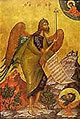

There are many holy ones, examples of the martyric witness of Orthodoxy throughout the history of America’s Transatlantic slave trade, Reconstruction, and Jim Crow semi-slavery and segregation. We can consider these the Holy Ones of American Slavery. It is their martyric witness of the faith that bridges the Black American experience of suffering to the Pontic Genocide and communism in Russia. The supplications of these unknown saints continue to echo throughout our nation and world.
The Orthodox mission to Black Americans, West Indians, and Caribbeans began in 1904 through the efforts of Archimandrite Raphael Morgan of blessed memory. Fr. Morgan became acquainted with Holy Orthodoxy through his close friendship to vagante bishop George Alexander McGuire. While McGuire failed to obtain valid Holy Orders to the priesthood, Fr. Morgan followed a humbler path and the tradition of glorification in the One, Holy, Catholic, and Apostolic Church. This Tradition is the charismatic transmission of the flames of Pentecost found in the lives of the Patriarchs, Prophets, Apostles, and Saints of all ages.
In recent years there have been challenges to the Orthodox ethos of Archimandrite Raphael Morgan. But serious academic research demonstrates that criticism of Fr. Morgan’s treatment of his ex-wife, promoted on sites like OrthodoxHistory.org, is unsustainable. Two Greek Orthodox attorneys have concluded that evidence used to besmirch Fr. Morgan’s reputation was based on lies motived by the divorce laws of the time.
The first divorce law in Pennsylvania, where Fr. Raphael and his wife resided, was passed in 1785.[1] This was the first divorce law in the nation to include cruel treatment as an acceptable reason for divorce. It was this law that would be the foundation for future Pennsylvania divorce laws on the processes and acceptable grounds for divorce.
The divorce process began with a written petition from the libellant to the court. After reviewing the petition, the court would release a subpoena for the respondent to appear in court and contest the charges laid against him/her. If the charges held merit, a court date would be set. Both parties would choose whether to be judged by a jury or the court. Court proceedings like the ones seen today were also followed in the 18th and 19th century: depositions of witnesses, testimonies, etc.
There were two distinct types of divorce that could result: bed and board or annulment. A divorce from bed and board was a legal separation. The woman would retain her dower rights and could also petition for alimony, but she could not legally remarry, whereas an annulment was a complete dissolution of the marriage. With this latter type of divorce, both parties could legally marry again. The legal grounds for divorce also changed over time. They began with only a few, such as desertion, adultery, and cruel treatment and subsequently expanded to include fraud and felony convictions.
The expanded grounds were in effect between 1785 and 1899. Therefore, there were only three causes of divorce to file at the time Charlotte Morgan filed for divorce from her then-husband, Fr. Raphael. She filed on the alleged charges of cruelty and failure to support their children. She left with the younger of their two children, Cyril, and remarried six months after the divorce was final. The older sibling, Viola, remained with her father and according to her baptismal record and transcript from Calvary Episcopal church, was baptized in a Black American chapel for crippled children, St. Michael and All Angels in West Philadelphia.
To examine the development of the laws of uncontested divorce in Philadelphia and the matter of the Morgan divorce, I offer the following information:
The Act Concerning Divorces and Alimony was enacted by the Representatives of the Freeman of the Commonwealth of Pennsylvania in General Assembly. This act gave the Supreme Court the ability to grant divorces as well. Grounds for divorce were expanded to include the inability to procreate, adultery, desertion, cruel treatment, and/or bigamy. Most divorces granted were restricted to bed and board (a legal separation), but the legislature also allowed for complete annulment.
To substantiate this legislation further, Section X[2] states: “If a man either deserts his wife or cruelly treats her, she will be allowed a divorce from bed and board.” This was a legal separation. These women could not legally remarry; however, they would retain their dower rights and could also petition the court for alimony. (According to Series 21 Number 24, December 1973 to 100 Years of Marriage and Divorce Statistics United States, 1867-1967, data from the National Vital Statistics System[3] pages 18 and 19 note.)
Relevant to Matthew Namee’s argument and the context of Fr. Morgan’s particular situation, “The proportion of contested divorce cases has always been comparatively low: 15.4% for the 1887-1906 period, 14.8% in 1922, declining to 11.9% in 1929.” It should also be noted that Charlotte Morgan was remarried to a businessman six months after her divorce from Fr. Raphael. Adding more context to these historical findings, Nicholas Pappas, one of the Greek Orthodox lawyers researching the case, affirms that most divorces from this period were widely uncontested; additionally, friends and family would often lie on the behalf of the libellant—in this case, Charlotte Morgan—to have the divorce granted.
Pappas has also recently shared the historical account of how Fr. Raphael continued his vocational activity as a priest in the island of Cyprus. A 1911 Article from the Church Herald-Cypriot Journal details Morgan’s service in the Apostolic Church of Cyprus.
With this historic record we see that Archimandrite Raphael did in fact maintain his priesthood following his divorce and he continued his inspiring missional effort to the African Diaspora in the West. Concerning the lives of Black men and women, it has been said, “Unless we tell it…it never gets told.” In the West, the lives and achievements of Black Americans have often been marred through the lens of careless reporting and/or revisionist history or obscured altogether. In light of this reality, historians need to take a more meticulous and measured approach to research, analyze and interpret data pertaining to the lives of Black American, West Indian, and Caribbean luminaries. As the Orthodox mission in America expands to include members of the African Diaspora, I pray that Black families of various ethnic backgrounds would begin to cherish and share stories of the Holy Ones who represent our experience.
The work of a scholar never calls to place an end to a story that is still being told…
by Rev. Samuel Davis