Patristic theology, and traditional teachings of Orthodoxy from the Church fathers of apostolic times to the present. All forum Rules apply. No polemics. No heated discussions. No name-calling.
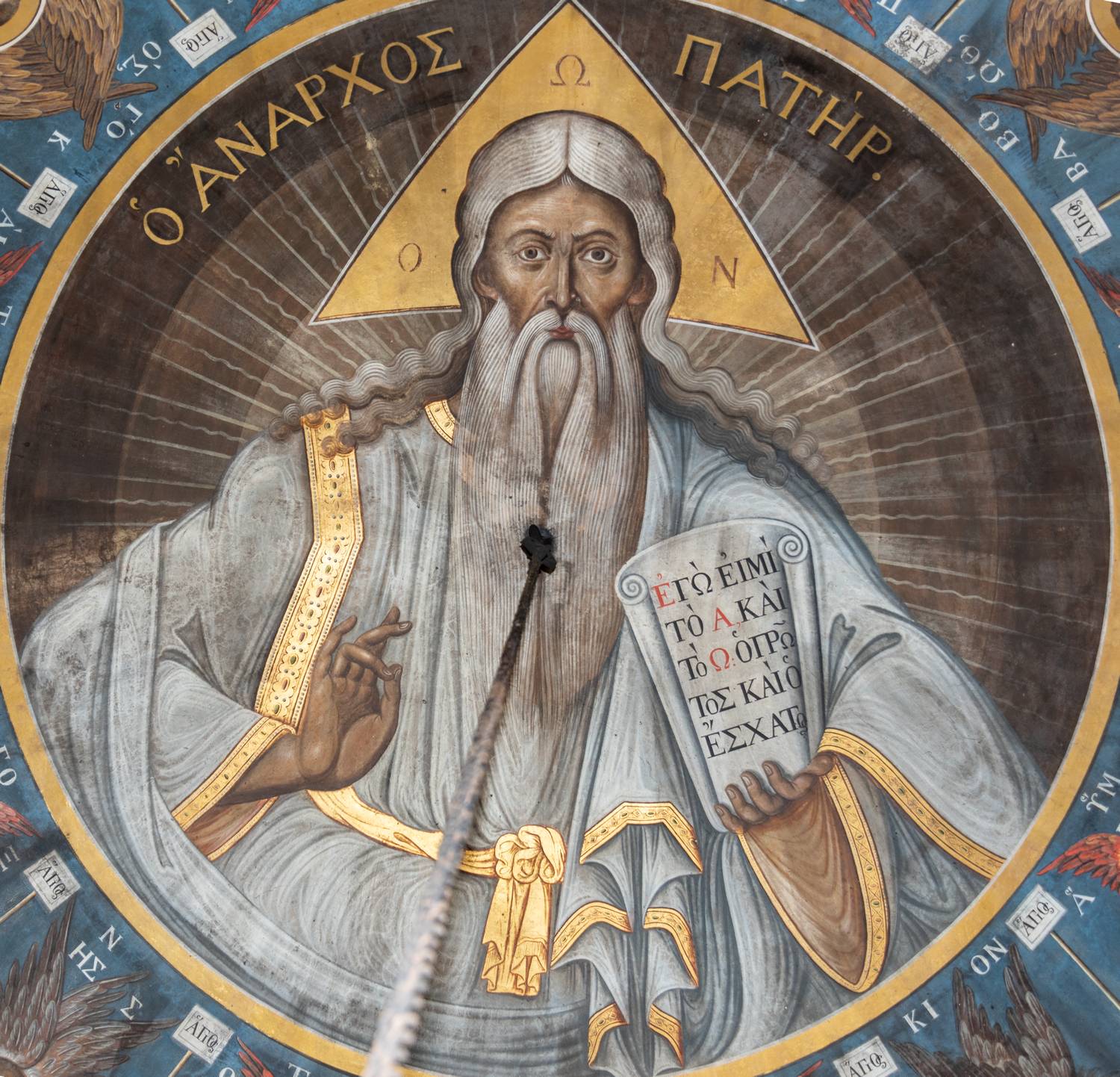
The issue is the proposition that the Father can be depicted or circumscribed as a Father in human form.
First of all Christ depicted Him in words as "Our Father."
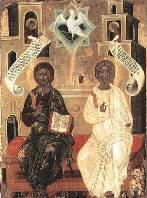
Second there are many ikons with the blessing hand of the Father depicted in the right upper corner and no one has protested against this to my knowledge.
Third- the Holy Spirit was circumscribed as a Dove in ikons of the Baptism of Christ.The Holy Spirit is also depicted as flames above the heads of the Apostles at Pentecost.
The Father as Ancient of Days has also been depicted in words in the Bible.
The Council of 1666 was redefined by ROCOR and St. Philaret in 1974 as having "never existed" due to the decisions related to the Old Rite and the persecution of St. Nikon by Tsar Alexi Romanov. I think it is also denied because of the canons on ikonography.
"Do not accept images of the Latin Holy Trinity, where the Father is depicted as an old man with the dove of the Holy Spirit and the Son crucified. This is idolatry and an ancient error of the Latins, which anthropomorphizes the incomprehensible nature of the Godhead. The Orthodox Church does not depict the Father, but only the Ascension of the Lord or the Hospitality of Abraham as a type of the Trinity. If such an icon enters the temple, grace is driven away, and demonic forces are summoned.
"Do not accept images of the Latin Holy Trinity, where the Father is depicted as an old man with the dove of the Holy Spirit and the Son crucified. This is idolatry and an ancient error of the Latins, which anthropomorphizes the incomprehensible nature of the Godhead. The Orthodox Church does not depict the Father, but only the Ascension of the Lord or the Hospitality of Abraham as a type of the Trinity. If such an icon enters the temple, grace is driven away, and demonic forces are summoned.
I doubt it’s genuine. That would be ironic, given that there is an icon depicting the Father in the Catholicon of Saint Anthony’s Monastery.
Here is Jay Dyer, all confused and teaching wrongly about the icons:
Heterodox Icons: Moscow Synod of 1666-67
His first mistake is relying upon 'The Meaning of Icons' (1952) by Leonid Ouspensky and Vladimir Lossky, who were, if I'm not mistaken, both associated with the schismatic Moscow Patriarchate.
His next argument goes: "Well, first of all the the Father didn't become incarnate and so it doesn't make any sense to picture Him as an old man, because He's not incarnate, and to picture Him as an old man would be to suggest that he was incarnate."
This argument is specious, for the Church accepts images of the Holy Spirit in the form of a dove, and this has not led to anyone in the Church to actually claim the Holy Spirit incarnated, assuming the nature and flesh of a bird.
Furthermore, there are many icons which depict Christ, as the pre-incarnate Word, shown as Creator. Icons showing Christ creating light, the heavenly bodies (sun, moon, and stars, etc.) the animals, the creation of Adam, etc.
Following the specious logic of Jay Dyer, this could lead people to think that the Word always had flesh, prior to the incarnation, and before the creation. Yet no one in the Orthodox Church thinks this.
What about icons of Christ Emmanuel, such as at Karakallou Monastery (Μονή Καρακάλλου) on Mount Athos, which depict Jesus with wings? Is that going to lead everyone into believing Christ actually has wings? Of course not. Also, angels and demons do not have wings, but they are depicted symbolically with wings.
So, this notion that images of God the Father portrayed as an old man, are going to lead people in the Church astray into heresy, thinking the Father has become incarnate, is preposterous.
Dyer suggests (blindly following the errors of Ouspensky/Lossky, Constantine Cavarnos, etc.) that the Paternity icon (with Christ holding the dove) somehow teaches the Filioque. Dyer says: "The Father is sending the Holy Spirit, together with the Son. So it's intended to convey the double hypostatic procession."
The Father does send the Holy Spirit with the Son, speaking of a temporal energetic manifestation. There is nothing unorthodox about saying the Holy Spirit is sent by the Father and the Son.
St. Gregory Palamas - Homily Eight:
"He is sent by the Father as well as the Son, and also comes on His own behalf, for sending, that is to say revelation, is the common work of the Father, the Son and the Spirit."
It is the hypostatic existence of the Spirit which is from the Father alone:
St. Gregory Palamas, Logos Apodeiktikos 2.20:
"Whenever you hear him [St. Maximus] say that the Holy Spirit proceeds from both, because it comes from the Father essentially through the Son, understand reverently that he is teaching that the natural powers and energies of God are poured forth but not the Spirit's divine hypostasis."
So, there is absolutely no issue or problem with a Paternity/Fatherhood icon, depicting what Jay Dyer chooses to interpret as: "The Father is sending the Holy Spirit, together with the Son."
He is conflating the hypostatic origin of the Spirit, with the energetic procession and manifestation.
Dyer appears to get all mixed up and confused: "The Ancient of Days icon is THE SON" (he says with emphasis)
But then a bit later towards the end of the video clip, he goes on to say:
"There is an Orthodox Ancient of Days icon. St. Nectarios talks about it being fine, and he says it is the Father."
So, make up your mind! Earlier, you insisted the Ancient of Days icon is THE SON. But then you admit, St. Nectarios says it's the Father, and it's fine.
So, it's hard to tell what exactly are the point of your objections, if St. Nektarios said there is an Ancient of Days icon which is the Father, and it's fine?
Here, new calendarist Fr. Peter (Heers) is preaching against veneration of icons of God the Father, hoping they will be "set aside eventually".
Should I Venerate Icons of God the Father?
He speaks of God the Father, He's in a triangle, and suggests this is "very much confused". Fr. Peter is the one who is very much confused. Just like so many others who have not studied and considered this topic carefully and thoroughly, he attempts to use the simplistic and specious argument that the Father should not be depicted, because He never became incarnate.
So what! The Holy Spirit never incarnated either, and yet, the Church, including the Seventh Ecumenical Council, has gladly received icons of the Holy Spirit depicted in the form of a dove. It is plainly obvious that it's not necessary for a Person of the Holy Trinity to have become incarnate in order to be depicted. If the Holy Spirit may be depicted, never having become incarnate, why can't the Father be depicted, also never having become incarnate?
St. John of Damascus says that we may depict all the forms that have been seen.
St. John of Damascus - Against the Iconoclasts, Part II:
"If Holy Scripture clothes God in figures which are apparently material, and can even be seen, they are still immaterial. They were seen by the prophets and those to whom they were revealed, not with bodily but with intellectual eyes. They were not seen by all. In a word it may be said that we can make images of all the forms which we see. We apprehend these as if they were seen."
"But Scripture offers forms and images even of God."
So, as everyone can see for himself, the Orthodox criterion is not what Fr. Peter, and all the others who ill-advisedly fight against the holy images of the Father mistakenly allege: that God must be incarnate in order to be depicted.
The Orthodox criterion is, as St. John Damascene states in explicit terms, has God the Father been seen in an assumed form? If He has, then He may be depicted.
Of course, St. Daniel the Prophet saw a vision of the Father as the Ancient of Days (Dan 7:13), and the Protomartyr St. Stephen saw not only Christ, but also the Father, as St. Gregory Palamas relates. This is why there is a 9th century Greek manuscript of the writings of St. John of Damascus, showing a depiction of the Protomartyr's vision, with Christ at the right hand of the Father.
There is nothing wrong or improper about using a triangle in the halo of God the Father. It is traditional and goes back many centuries.
Here, for example, is a large and clear example from the Pantokratoros Monastery (Ιερά Μονή Παντοκράτορος) on Mount Athos in Greece dating to the 1360s.